 Review by-Jarrett Leahy
Lars von Trier is an eccentric Danish auteur filmmaker whose collection of unconventional creations often baffles and frustrates even the most ardent of cinephiles. My first introduction to Lars was his 2009 drama, Antichrist, and I have yet to remove from my memory one of the most erotically grotesque images ever depicted. If you’ve seen the film, you know to what I refer; if you haven’t, I’ll save you the gory details. Von Trier began making feature films in the 1980’s, but it wasn’t until his 1991 foreign drama Europa that he became a recognized name in the international movie scene. Ever the provocateur, he has made films that deal with a bevy of onerous topics that all seem to come back to the inherent flaws and frailties of the human condition, especially our innate sexual desires.
Nymphomaniac expands on those ideas, telling the story of a self-described sex addict as she chronicles her life’s carnal escapades to a man who has recently rescued her from a back-alley gutter after she suffers a severe beating. Clocking in at just over four hours long, von Trier wisely decided to split his sexual opus into two volumes, which I found helped make the overall film much easier to digest. Although, I suspect with how engrossing I found the first volume, I would have had little problem immediately continuing my viewing of Volume 2 if I had had both discs.
 Our film’s central character, Joe, is portrayed by two actresses, Charlotte Gainsbourg and Stacy Martin. Gainsbourg plays the older Joe while also narrating the film’s many flashbacks. Gainsbourg, a daring and talented veteran English actress, has appeared in two other von Trier films, Melancholia and Antichrist (she is the one who forever scarred my psyche). Because she is the narrator recounting her story, for much of the first volume of Nymphomaniac, we only see her lying in bed recovering from her injuries, while Martin, who was cast to portray the younger Joe, is asked to perform many of the character’s graphic exploits. Nymphomaniac is Martin’s first film, and what a daring and challenging role to begin one’s career. These two women are put through the wringer in the name of art, and I will tip my hat to their commitment to this extremely demanding character.
 Stellan Skarsgard’s portrayal of Seligman, the asexual intellectual, is a foil narrative device used by von Trier to contrast Joe’s salacious tales with more levelheaded and well educated counter perspectives. While Gainsbourg’s character often perceives herself as an evil person whose voracious desires have negatively impacted so many in her wake, Seligman instead sees her constant cravings and insatiable sexual appetite as innate needs unique to her as a human creature. The conversations these two characters share during her story are fascinating, philosophical, provocative, and even a bit pretentious at times. Unfortunately, von Trier’s lazy choice on how to end the film diminishes some of their previous interactions.
 After receiving an NC-17 valuation from the MPAA, the studio decided to surrender the rating and release the film unrated. Nymphomaniac is obviously graphic in nature—how graphic, I suppose, depends on each viewer’s personal definition of what is explicit. Perhaps due to my past experiences with von Trier films, I found the sexual acts depicted in Volume 1, while plentiful, to be less vulgar than initially anticipated. Volume 2, however, offers much more lewd subject matter including a storyline involving S&M, and von Trier does not hold back in the visuals shown.
 There is little doubt that Nymphomaniac is a divisive creation that elicits strong and varied reactions. Overall, I found Volume 1 a far more engrossing and compelling film, offering unusually keen and abstract conversations between Gainsbourg and Skarsgard, along with surprisingly competent performances from both Christian Slater and Shia LaBeouf. Volume 2 struggles slightly with a narrative that begins to wander, straying into more puzzling and esoteric subject matter while also suffering from an ending that I found ineffectively anticlimactic. As a whole, Nymphomaniac is not for those with more modest tastes but is worth the risk for film fans interested in more experimental cinema.-JL
 Review by-Jarrett Leahy
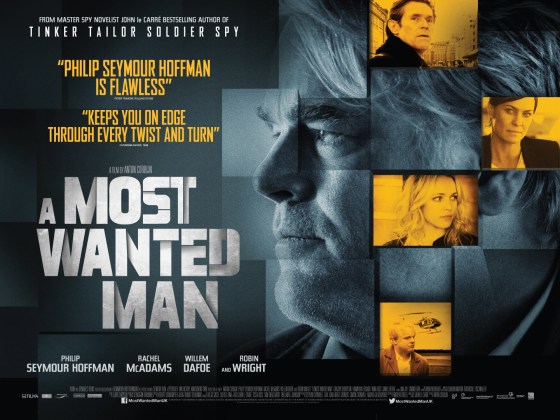
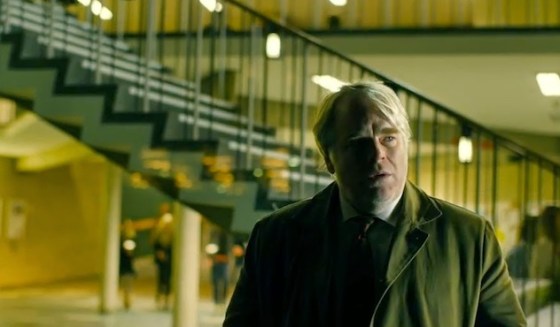
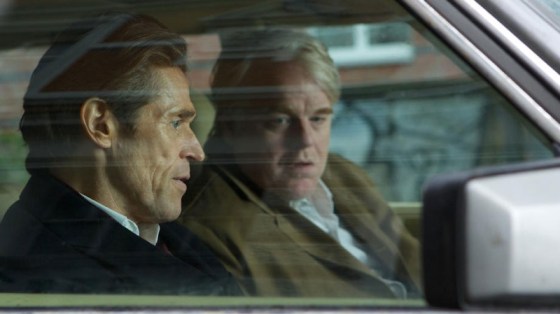 Based on a novel from famed author John le Carre (Tinker Taylor Soldier Spy, The Constant Gardner, The Spy Who Came in From the Cold) A Most Wanted Man flawlessly entwines numerous storylines, creating an unnerving and exquisitely interwoven modern-day espionage thriller filled with a multitude of unexpected twists and turns. The star attraction of the film is the late Academy Award winner Philip Seymour Hoffman. As I sat captivated by yet another of his first-rate portrayals, I found it impossible to escape the thought that this was one of our final chances to see how extraordinary an actor he was. Hoffman, in fact, is phenomenal, turning what would have been a solid spy thriller into one far more noteworthy. His character, Gunther Bachmann, is the head of a secret German anti-terrorism team charged with recruiting informants to spy and report on the goings-on in the German Islamic community. In this loathsome and dangerous world of ever-shifting allegiances, it’s through Hoffman’s masterful delivery that we trust this Bachmann character. Despite his personal foibles, this is a good man who truly believes in the importance of the work he and his team does and values the lives of the sources that trust him and his word. While it took a minute or two to get accustomed to the German accent, Hoffman remarkably does what he always managed to do, completely embody and disappear into his character. It was apparent right from the opening scenes this was his picture, as he set the precise tone for the film while everyone around him seemed to amiably play off his tenor and expertise.
 The success of A Most Wanted Man can also be attributed to the film’s Dutch director, Anton Corbijn, a talent who I have little problem declaring one the most underrated filmmakers in the business today. Originally an accomplished still photographer, Corbijn broke into the industry in the 1990’s as a music documentarian, working with the likes of U2 and Depeche Mode. After his debut feature film, Control, became a moderate critical success, Corbijn showed off his true filmmaking gifts with his 2010 drama The American, an impeccably crafted masterwork that harkened back to legendary filmmakers like Michelangelo Antonioni and Jean-Pierre Melville. A very European-styled film with high tension, little dialogue, and extraordinary cinematography, The American suffered immensely from a botched marketing campaign as its distributors had no idea how to sell an art house film starring George Clooney.
 The standout among the film’s talented supporting cast that includes Willem Dafoe, Rachel McAdams and Daniel Bruel, is Robin Wright who offers one of her most deliciously devious performances as C.I.A. agent Martha Sullivan. Wright does an exceptional job creating a character whose true motivations remain muddled throughout. I’m now afraid the nuanced subtlety Wright brought to make her character so elusive in the film will cause some Academy voters to miss how impressive her portrayal really is. I look forward to revisiting this film in the future in order to devote more attention to her cunningly sly performance.
 With an avalanche of disposable entertainment all hailed as the best blockbuster one week only to be forgotten the next, it was a refreshing change to be offered a piece of cinema that requires true thought and an actual attention span. Sadly, A Most Wanted Man is one of the few remaining testimonials of the excellence of Philip Seymour Hoffman’s gift as an actor. A slow-burner with a frenetic climax, A Most Wanted Man is a skillfully crafted spy thriller that helps remind us how riveting this genre can be when done right.-JL
 Review by-Jarrett Leahy
 For better or worse, filmmaker Luc Besson has always danced to the beat of a different drummer. Some of his unique creations like The Fifth Element and Leon: The Professional have found cult status reputations, while other more recent efforts have been labeled abysmal failures. As I was bombarded with the sensory overload of his latest action sci-fi orgy, I was forced to concede that Lucy is excessively absurd even for a filmmaker as eccentric Besson. Anyone familiar with his work knows that he has quite the infatuation with exaggerated action and violence. Unfortunately, Lucy takes that obsession to brainlessly new levels. Hoards of henchmen and police officers materialize almost out of thin air, each armed with enough firepower to level city blocks, yet they manage to miss each other from twenty yards away. Crime boss Mr. Yang, played by Oldboy star Min-sik Choi, has knives plunged straight through his hands, causing injuries that would require serious medical attention. Yet mere days later, Mr. Yang is seen sporting the most basic of hand bandages while still possessing a full range of motion to unleash a hail of bullets from his pair of handguns.
 As it has been pointed out ad nauseam, the science involved in Lucy is inherently flawed and imprecise. Besson builds the film’s story around the ten percent brain myth, a falsely-premised theory originated during the late 19
 Lucy is one of the most ambitiously preposterous nonsense films of recent memory. To fully grasp the depths of its imaginative and outlandish conjectures and theorems is something that can only be experienced firsthand. However, as dumbfounded as I felt walking out of my showing, I was just as…amused by Besson’s brazen chutzpah for even attempting such a film. Equal parts wonderment and stupidity, Lucy is an audacious and ambitiously witless failure filled with a cornucopia of eye-catching visuals that manages to raise a few interesting questions about the mysteries surrounding our mind and the universe.-JL
 Review by-Jarrett Leahy
 The story hinges on the shoulders of our protagonist, Gretta, a British songwriter who followed Dave, her musician boyfriend and writing partner, to New York City as his career begins to take off. Predictably, Dave finds the temptations of his newly found fame too enticing, and Gretta is forced to set out on Hollywood’s much beloved and well-worn path of discovery and growth as an artist and independent woman. Keira Knightley was brought in to play Gretta after Scarlett Johansson had to drop out. Sadly I must declare Knightley was simply miscast for this role, as her cultured and prim British persona never convinced me she was this expressively capable singer/songwriter. On top of that, while it was honorable for her to try, if we’re being totally honest here, she can’t sing. I suspect much of the film’s innoxiously bland music was selected to help mask that glaring fact. I could have seen an actress like Brie Larson or Mae Whitman offering a much more credible and convincing portrayal. Regardless, they should have seriously considered dubbing Knightley’s vocals.
 Mark Ruffalo has established himself as one of the most respectable and downright charismatic leading men in Hollywood, which is what kills me about his role in Begin Again. The humor Carney infused into the role of Dan simply made Ruffalo come off as a callous, childish douchebag. Even with his stereotypical story arc of redemption and renewal, at no point did the film ever give me an honest reason to root for this man. What’s worse, the believability of this supposed creative partnership between these two was severely lacking, as I found their on-screen pairing to be awkwardly contrived.
 The supporting cast offers yet more examples of miscast and underutilized talent. Two-time Academy Award nominee Catherine Keener was relegated to the snarky estranged wife and glorified chauffeur. Hailee Steinfeld, an Academy Award nominee in her own right, is too talented a young actress to be playing these cliched hormonal teenybopper parts. In all honesty, for as little as they gave her to do, they would have been better off casting an unknown for her role. And then there is Adam Levine, the lead singer of Maroon 5 and adored judge on The Voice. While it was glaringly obvious he has very little talent as actor, I must give him kudos for bringing just enough charisma to his portrayal of Dave to avoid completely falling flat on his face. Although if he had, it might have helped cover up that awful beard he was sporting for half the movie.
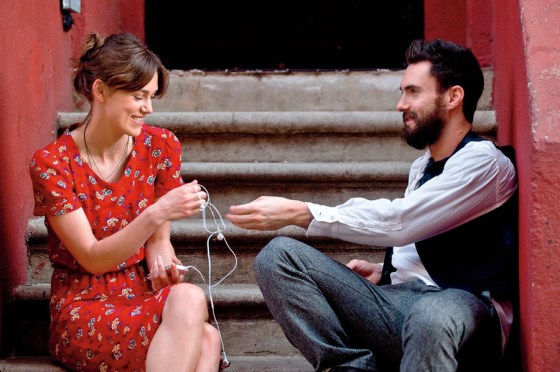 With the tremendous success of Once, Carney should have been first to understand how vital a killer soundtrack can be to the success of a film, especially when the subject matter involves the music industry. I was floored then by how grievously banal and vanilla the music chosen for Begin Again wound up being. The whole premise of the movie was built around the idea that this down-on-his-luck record executive has just discovered an artist whose talents as a songwriter are so eye-opening that it inspires his fervent backing and support. However, nothing Gretta wound up “creating” warranted anywhere close to the impassioned response it got from Ruffalo’s character.
 Review by-Jarrett Leahy
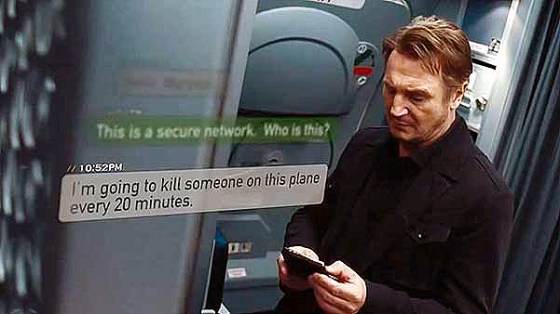 Similar in nature to Joel Schumacher’s 2002 mystery thriller, Phone Booth, Non-Stop has an amusing, over-the-top quality that feels a bit like a throwback homage to the B-movie disaster films of 1970’s. Being confined, for a large majority of the movie, in the cramped settings of a commuter plane offers a heightened claustrophobic feel, adding to the film’s tension and uncertainty, as we try to closely scrutinize each passenger. Knowing this, the camera seems to linger playfully on certain commuters, as if silently asking the viewer, “Do you think it’s him? What about her?” However, what makes Non-Stop a successful thriller is its cagey ability to never cast obvious suspicions on any one passenger, which in turn makes just about everyone on the plane a possible suspect, including Neeson. This ably strings us along as the engrossing absurdity begins to mount. We simply need to know who is responsible for all this madness.
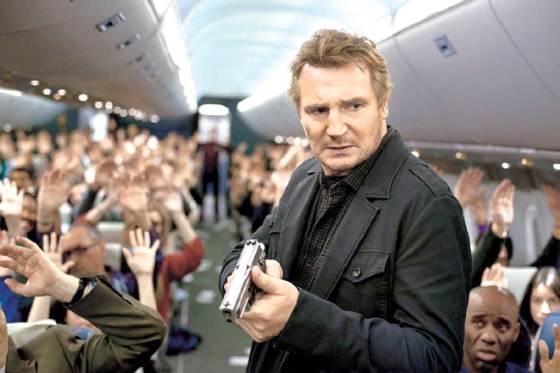 Non-Stop’s unusually gifted supporting cast, including Scoot McNairy (Argo, Killing Them Softly), Michelle Dockery (Downton Abby), Academy Award winner Lupita Nyong’o (12 Years a Slave), and most notably, four-Time Oscar nominee Julianne Moore, aided my enjoyment greatly. It was in fact Moore’s casting that I found brought a highest level of respectability and cohesion to this farfetched thriller. The uncommonly cool, withdrawn persona her character exudes did cast shrouds of doubt to her innocence in this disorienting mystery. A few times I found myself questioning what exactly were her motives for helping this desperate air marshal? Moore and Neeson last worked together on the 2009 critically panned Chloe. Seeing them get a second chance to perform on screen again was an unanticipated treat.
 Non-Stop is obviously not Oscar-worthy material, but for a film that was originally released during the typically fruitless first few months of the new movie year, it is a surprisingly shrewd, entertaining, and tense thriller. While admittedly the ending flies off the handles, the previous portions of the film left me so on edge that the wildly climactic conclusion was almost a welcomed release from the diverting anxiety that had built up. I can now see why Jason, one of our contributing writers, had it listed on his Mid-Year ballot of memorable movies from the first half of 2014. It’s a Liam Neeson thriller definitely worth checking out.-JL
 AmateurCinephile.com