IN MEMORIAM TOP 6 LIST: BOB HOSKINS
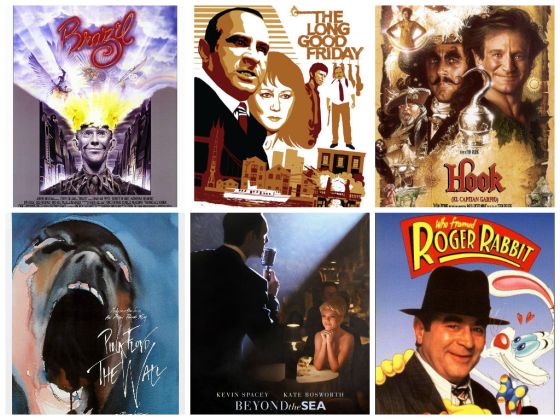
 List by-Jarrett Leahy
Former child star Joseph Gordon-Levitt was already a fixture in Hollywood even before his small role as Young Norman in Robert Redford’s 1992 period drama, A River Runs Through It. After a successful television career that included a six year run on the cult hit, 3rd Rock From The Sun, Levitt forged ahead, starring in a handful of independent films, showing an infinite potential to be a future movie star. During this new decade, Levitt has proven his fans correct, offering a wide range of successful roles and films that only continue to impress. This week’s Top 6 list takes a look at some of these entertaining films. (As a side note, if this were a true top 6, films like Inception, Lincoln, and The Dark Knight Rises would have been listed. However, since these films have already been highlighted in previous Top 6 lists and Levitt’s roles in each were of the supporting nature, I decided to instead use this opportunity to highlight a few others.)
6. Premium Rush (2012) A hotshot New York City bicycle messenger is hunted by a corrupt police officer after he picks up a highly sought after envelope. A pulse-pounding, fast-paced thrill ride, Premium Rush combined with Looper, The Dark Knight Rises, and Lincoln made 2012 one heck of movie year for Levitt.

5. Don Jon (2013) Levitt’s directorial debut, Don Jon is the amusing story of a stereotypical New Jersey guy who struggles to find happiness and contentment with real life intimacy after his addictive obsession with online porn has created unrealistic expectations about sex and relationships. With a script written by Levitt as well, Don Jon is a confident and absorbing first effort that makes acute statements about today’s sexualized and overstimulated modern society.

4. The Lookout (2007) A devastating accident has left Chris, a former high school hockey star, with a debilitating brain injury causing major memory issues. These memory lapses make having a real job next to impossible, so Chris instead works the night shift at a bank as the cleaning person. When a couple of local thugs learn of Chris’ mental difficulties, they try to recruit him for a plan to rob the bank. The Lookout was a surprisingly sharp and stylish crime thriller, led by Levitt, who skillfully personified the complications and clouded confusion faced by a man suffering from brain trauma.

3. 50/50 (2011) Based on a true story, 50/50 tells of a struggles faced by a 20 something after receiving the terrifying news of a cancer diagnosis. A comedic drama, Levitt brings a genuine sincerity and a touch of humor to this difficult subject matter. Seth Rogen gives one of his best supporting performances, and Anna Kendrick is her usual ethereal self. Please don’t let the daunting subject of cancer scare you away, 50/50 is truly a poignant and moving film.

2. Looper (2012) In the year 2074, time travel is created and immediately banned, opening up a black market for the mob to send people back in time where a paid hitman, or a looper, is waiting to kill and dispose of the body. When Joe’s older self is sent back for assassination, Joe hesitates, allowing his future self to escape. Levitt and Bruce Willis team up with rising director Rian Johnson in this tense, intelligent, and surprisingly original sci-fi thriller.

1. (500) Days of Summer (2009) Tom is a failed architect working at a greeting card company where he meets Summer, the new office secretary fresh off the bus from Michigan. Despite Summer’s admitted belief that there is no such thing as true love, Tom is instantly smitten and is determined to prove her wrong. The chemistry between Levitt and Zooey Deschanel is electrifying. Through the use of entertainingly nonlinear narrative, director Marc Webb created one of the best and most original romantic comedies since Annie Hall. (500) Days of Summer is an absolute gem.-JL

 Review by-Jarrett Leahy
Dr. Will Castor is one of the top experts in the expanding field of artificial intelligence and is on the cusp of creating a fully conscious, cognizant machine with ability to understand and express a full range of human emotions. His scientific success has raised dire concerns with R.I.F.T., a group of anti-technology radicals who fear the unforeseen consequences of his research and will stop at nothing to prevent him from succeeding. When R.I.F.T. executes a highly systematized and coordinated attack on the A.I. community, Dr. Castor’s life is put in jeopardy. Castor’s wife, Evelyn, and research partner, Max Waters, believe the only way to save Will is through transcendence, the uploading of his consciousness. Without the restraints of the physical world, Will is able to quickly acquire vast amounts of information, evolving far beyond anything ever imagined. But when his thirst for knowledge expands into a pursuit for power, it becomes alarmingly apparent that there may be no way to stop him.
After an extremely successful career as the director of photography for filmmaker Christopher Nolan that included four Oscar nominations and an Academy award for his cinematography work on The Dark Knight, Wally Pfister makes his directorial debut with Transcendence. As I’m sure Pfister learned first-hand, regardless of how complicatedly elaborate Nolan’s stories were (i.e. Memento, Inception, The Prestige), the driving forces to their success were accomplished screenplays free of overtly glaring plot holes. Story inconsistencies or illogical gaps can sink a movie even faster than inferior performances. And it is in these dreaded illogical gaps where we find the biggest issues with Transcendence.
Initial red flags were raised when little explanation was given as to how exactly the process of Transcendence actually works. Sensors were surgically attached, “data” was uploaded and collected, and miraculously it worked. If that was the film’s biggest quandary, we’d be in business for a solid thriller. However, that was just the beginning. Issues arose when the new digital Dr. Castor was allowed to create this technological oasis in the middle of the desert without any interference from government officials of any kind. Puzzled, I distinctly remember asking myself, “How is this going on unchecked? Where exactly did all the materials needed for this project come from? And how could a facility so complex and sophisticated be created in such a short time frame?” I also had major contention with the scale of the forces used in the attempt to disarm Dr. Castor. Loyalties inexplicably shift in a blink, and if this impregnable, highly intelligent artificial being is such a global threat, shouldn’t a far larger and unified response have been unleashed than what was eventually deployed for the mission?
 Frustrations were also found in the distressing prevalence of unexceptional, run-of-the-mill performances that were given by what most would consider an exceptional group of actors who certainly aren’t known for mediocrity. Front and center is Johnny Depp’s wooden depiction of Dr. Castor. Perhaps he was attempting to portray the cold, unemotional delivery of a non-human intelligence, but what came across instead was a dispassionate and detached performance that almost looked as if he were sedated. It also pains me to concede that I’ve never been more disappointed with Morgan Freeman and Paul Bettany, who both appear to be going through the motions on screen.
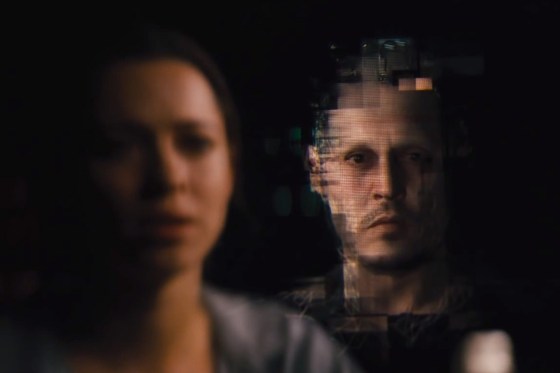 While the film itself is disappointingly lacking, my appreciation for it lies in the thoughts and questions I found myself asking while watching it. Examining the notes I scribbled down in the dark, I found these reflections and questions. Seeing how rapidly technology has expanded in the last decade, how close are we actually to an omnipresent artificial intelligence? If we are heading down this path and researchers begin to experience similar difficulties, would they have the courage to pull the plug on years of research, or would their egos be the eventual demise of our society? The film examines ideas about healing the damage we’ve caused to our planet, and as destructive as we are as a species, would this type of symbiotic system Dr. Castor’s digital self was trying to construct be a solution for our future survival? Transcendence is going to be looked at as the first box-office bomb of 2014. But if a film can conjure such philosophical questions as these, can it be considered a true failure?
After the film let out, Jason asked me what I thought of it. The only response I could come up with was, “It’s a thought-provoking pile of mediocre.” Transcendence rolled out the red carpet with the big ad campaign and A-list cast to help masquerade the film’s two glaringly obvious flaws, a first-time director working with a flawed script from a first-time writer. Overall, my best designation for Transcendence is it’s a fascinating failure.-JL
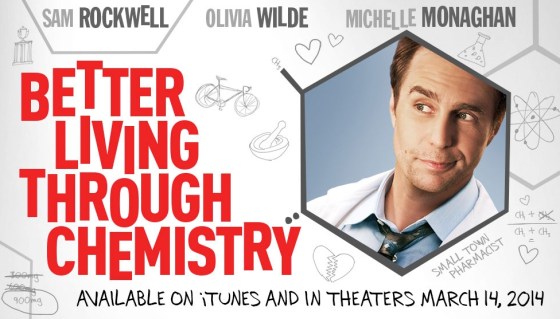
In a quiet, idyllic postcard of a town, Doug Varney is a straight-edge pharmacist with a crazed cyclist wife, an alternative son whose erratic behavior is getting more and more bizarre, and a domineering father-in-law with a propensity for disapproving criticism. Unexpectedly, Doug’s humdrum life gets a much needed shot of adrenaline after he begins an illicit relationship with customer Elizabeth Roberts, an unhappy, pill-popping, trophy wife who helps open Doug’s eyes to a world of possibilities. However, these newly found personal discoveries come at a cost, and when Elizabeth gets Doug hooked on his own prescription supply, his life quickly begins to spiral out of control, putting both his family and his business in jeopardy.
 The story arc for Better Living Through Chemistry is easily foretold, with few surprising deviations from the obvious. But that doesn’t keep it from offering some amiable moments including a touching and amusing subplot surrounding the odd behavior of Doug’s son Ethan as he tries to come to grips with the difficulties of adolescence. As expected, the highlight of Better Living Through Chemistry is Sam Rockwell who offers yet another charmingly wacky comedic performance. As Doug discovers the benefits and pitfalls of his newfound love of prescription drugs, Rockwell easily slips in and out of the various stages of the character’s manic behavior. After stealing the show in last year’s surprise coming of age comedy, The Way Way Back, I had high hopes Rockwell would have another career surge. Unfortunately, being a gifted and versatile actor just hasn’t seemed to translate over to box office success for Sam.
 Looking at the gluttony of mediocre mainstream options being peddled in most cineplexes these last few months, I have to admit to being a bit surprised that a comedy with names like Sam Rockwell, Olivia Wilde, Michelle Monaghan, Ray Liotta, and Jane Fonda, was treated with such irreverent indifference, with it receiving only a very limited theater release in March and already available in Redbox less than a month later. In the past, straight to DVD was an absolute kiss of death for a film, however with today’s ever expanding variety of home theater options including Netflix streaming, Redbox, and the various video on demand services, a film like this one luckily has the opportunity find enough of an audience to at least have a chance at recouping the investors’ capital. Better Living Through Chemistry never gets better than your average, run-of-the-mill comedy. Saying that, it’s still better than half the crap starring flavor of the month, Kevin Hart, and deserved better than the relative obscurity to which its studio relegated it.-JL

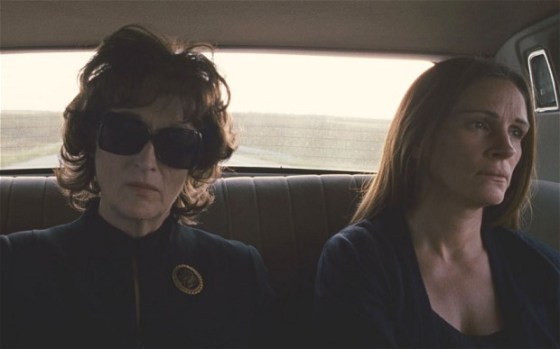
After Beverly, the Weston family patriarch, mysteriously disappears, the three Weston sisters and their maladjusted extended family return to the Oklahoma family house to try to offer support to their ornery, dysfunctional mother from whom they’ve so desperately tried to escape. Based on the 2008 Pulitzer Prize winning play written by Tracy Letts, August: Osage County is a boisterous and unrestrained family melodrama filled with a deluge of portentous roles actors clamor to get their hands on. Similar to another Broadway adaptation, Who’s Afraid of Virginia Woolf?, the unrelenting and ever-escalating drama of August: Osage County can be a bit overwhelming at times. The crowning jewel of the film’s volatile dysfunction is the now infamous dinner scene in which Julia Robert’s character Barbara attacks Meryl Streep’s Violet after a barrage of pharmaceutically enhanced “truth telling” pushes her over the brink. Kudos must be imparted to the actors for their commitment to the bedlam, but even with warnings of this impending altercation (the scene was even depicted on one of the movie posters), I quickly discovered I wasn’t quite prepared for the maniacal chaos that unfolded.
 The canonical reverence for Meryl Streep is beyond publicized, but please allow me to add to it. Her transformation into a chain-smoking, pill-popping addict suffering from oral cancer is astonishing. The vitriol and unfiltered language that spews from her mouth directed at her family is amusingly abrasive and the top source of the film’s black humor. While watching Streep’s incomparable depiction of a drug-induced, disoriented stupor, I came to the obvious conclusion that she simply has to be an alien from another planet. Her acting talents are so above any of her contemporaries that I truly think this must be what it was like back in the 1920’s to see Babe Ruth in his prime.
 The yin to Streep’s lunatic yang comes from Julia Roberts’ devastating portrayal of daughter Barbara, a woman who is so desperately trying to hide the anguish caused by a failing marriage, the disappearance of her father, and the guilt trip assault verbally unleashed by her mother for escaping and setting out on her own. Known more for her All-American good looks and radiant grin, Roberts’ austere, natural appearance here allows for a more adept depiction her character’s inner turmoil. One of the most emotionally dense performances of her career, Robert’s Oscar nomination was well deserved.
With all of August: Osage County’s jarring disharmony, surprisingly the scene that most resonated with me was a relatively placid late night confab shared between the three sisters. Stylistically reminiscent of a conversation scene in Woody Allen’s Hannah And Her Sisters with the camera circling the three, this docile exchange offers a bit of respite from the discord, allowing us a more intimate glimpse at the interaction dynamics of these three women without the overbearing presence of their mother. I’d also be remiss if I didn’t extend a quick acknowledgment of the gifted supporting performance given by rising British star Benedict Cumberbatch. Of the many A-list stars rounding out the cast, it was Cumberbatch’s vulnerable and exposed portrayal of cousin Little Charles that is most noteworthy.

Unfortunately, August: Osage County is one of those rare films that contains impressive performances that don’t add up to an impressive film. Foreboding and unremittingly melodramatic, the lasting impact of August: Osage County will be as a vessel for two imposing performances and a reminder that having great source material doesn’t always guarantee great cinema.-JL
 AmateurCinephile.com