2,000 Page Views!
We reached another small yet very cool milestone for the page today, 2,000 pages views from 46 different countries.



Under The Skin (2014)
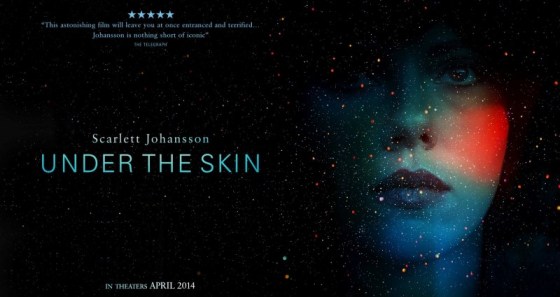 Review by-Jarrett Leahy
“A masterpiece!” “Artsy-fartsy garbage.” “The best film of 2014.” “The worst movie I’ve ever seen!” Any film that can create such diversely opposing yet equally passionate reactions would certainly fall under the category of being a polarizing or divisive film. I suspect that many casual movie fans and more than a handful of those with a discerning appreciation for finer cinema will have a difficult time embracing the ambiguity and esoteric nature of Under The Skin. The premise is quite simple: an alien entity has taken human form and, with the help of another alien being, begins covertly wreaking havoc on the male population of Scotland, using her extremely voluptuous allure to entice lonely fellas into her van for a good time, only to devour these poor unsuspecting saps.
 Sounds intriguingly similar to films like Species, right? Well it most definitely is. However, what many have had issue with is the way filmmaker Jonathan Glazer took a familiar sci-fi premise and completely deconstructed it, using overtly opaque symbolism and visuals to play with the viewers’ minds and create unusual moments of distortion. Instead of depicting these unlucky gentlemen simply being eaten by killed by these extraterrestrials, Glazer uses an unusually abstract visual of the men slowly sinking into the black floor as they longingly pursue this sexual creature across a stark, empty room. I found this artistic abstraction to be an erotic and suggestive re-imagining of an archetypal scene abundantly found in the alien sub-genre of science fiction cinema. It appears unfortunately, not everyone was so appreciative of Glazer’s unconventional efforts.
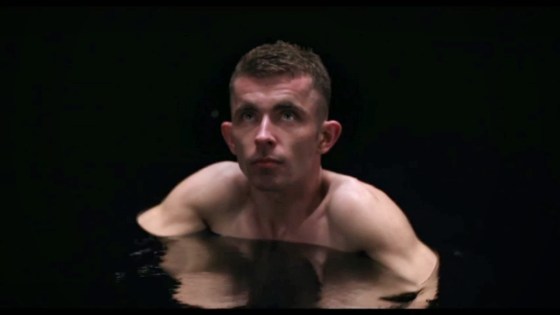 In large part, this film is told from the perspective of this alien creature who has yet developed the know-how to filter out the over-stimulation of this foreign population. A cacophonous, discordant musical score, the overtly chaotic use of background noises, and layered, over-saturated colors and graphics all add a feeling of discord as this creature is bombarded by this new world around her. During an early scene where she wanders into a local mall searching for various beauty supplies to aid in her mission, an unrelentingly turbid hum of conversations and laughing besiege her from all sides. Some will find these tumultuous visuals ingenious, others will simply be exasperated.
 Scarlett Johansson offers one of the most unexpected and noteworthy performances of her career. Johansson precisely captures the cold, deadpan facial expressions of this foreign invader who has little experience with true human emotion. Only during times when she is on the prowl, do we see her character offer what she perceives is a personality that will efficiently beguile her marks. The film puts her character in a bevy of situations that would illicit even the most basic of emotional response in just about any human to help patently exhibit the utter disconnect she has for her prey. As the film progresses however, we can see slivers of change in this character, thanks in large part to Johansson’s astutely understated portrayal. Unfortunately for many, Under The Skin will simply be regarded as the film Johansson finally stripped down. But rarely do we see movie stars of Scarlett’s immense fame take on such high risk roles, and in certain circles, this film will be yet another example of how gifted and diverse an actress she truly is.
 Under The Skin is a bizarrely unconventional and polarizing piece of science fiction that has both wowed and angered viewers. However, whether you love it or loathe it, I can promise you’ll have a difficult time forgetting the jolting images of the film’s final scenes. Another example of advanced cinema, I found Jonathan Glazer’s Under the Skin to be an abstract, re-imagining of the body snatchers fable that completely engulfed me in its hallucinatory, mystifying terror. Never has the Scottish countryside felt and looked so ominously menacing. The cinematography is an intoxicating feast for the eyes and Scarlett Johansson gives a truly carnal performance that is both captivating and unnerving.-JL
Grade: B+
RoboCop (2014)
 Review by-Jarrett Leahy
Set in 2028, the streets of Detroit have become a glorified war-zone of crime and corrupt officials. Fervent media and conservative politicians hope that the country’s growing fear will speed up the institution of a controversial militarized robotics program headed by multinational corporation OmniCorp. However, America’s “robo-phobia” keeps their lucrative plans at bay. When a dedicated Detroit police officer, Alex Murphy, is critically injured on the job, OmniCorp sees this as their opportunity to use their robotics technology to save this new hero and create a more human-like robot in the hopes of swaying the American public to support their burgeoning business that has already been unveiled in many other parts of the world.
This latest reincarnation of RoboCop is yet another example of how the current movie industry lassos talented up and coming filmmakers, uses, abuses, and forces them to spawn one of their latest crap remakes. Brazilian director Jose Padilha made a name for himself on the international film scene with his action crime drama, Elite Squad, the 2008 Berlin Film Festival Golden Bear winner. Three years later he released an equally successful sequel, Elite Squad: The Enemy Within, and officially became a filmmaker on the rise. Unfortunately, I fear that RoboCop is such a major misstep that Padilha has possibly flushed away all his career momentum in one fell swoop. While attempting to create an allegory for the dangers of using misguided and warped rhetoric to justify the mass stripping of civil liberties, Padilha embraced the most hackneyed and cliched action stereotypes to create a film that does nothing to honor or better this franchise’s previous efforts.
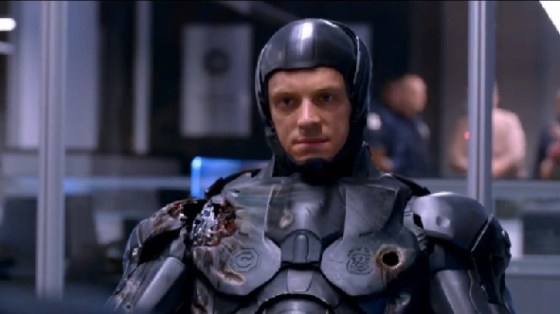
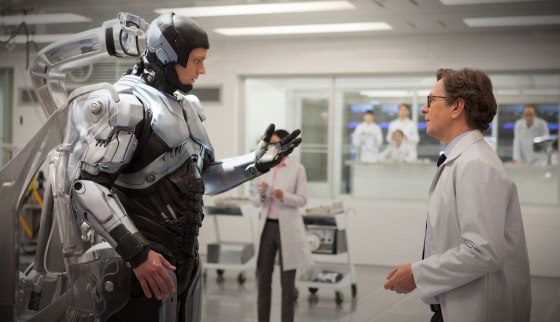 Because the title character is obviously a robotically enhanced humanoid, the main requirement for the actor playing the part was to simply offer their interpretation or version of the unemotional delivery our robotic friends are famously known for. Unfortunately, Joel Kinnaman, the unknown Swedish eye candy that was curiously cast to lead this superfluous remake, took that idea a little too far, giving a dismally wooden performance that had me questioning whether he was in fact trying to channel his inner Hayden Christensen. Even is vacant, expressionless stare, which seemed to be on constant display, felt like a painstakingly laborious task for our ineffectual hero. During this latest deluge of action franchise reboots, I’m all for giving fresh faces a chance to become the next superstars. But in the future, it would be great if the studio would make acting talent and the charisma to carry such a movie prerequisites in their casting process.
 And that leads me to Ms. Cornish. After this latest in a long line of vapid attempts at acting, I have officially given up on Abbie Cornish. In fact, I should have known better, when with all of the actresses at their disposal, she was the one chosen for this film. Her monotone, emotional rag portrayal becomes increasingly tiresome, throwing even more fuel on my frustration with this tediously mindless creation. Other supporting stars of the film include Gary Oldman, Samuel L. Jackson, and Michael Keaton. While we’ve long since known that Jackson will agree to do any movie that pays, and Keaton should just be happy that was cast in anything, an actor as gifted and respected as Gary Oldman should have taken one look at this tripe script and simply said NO. On top of playing the stereotypical good-hearted scientist whose work has been corrupted by big business greed, half of Oldman’s lines wound up being him simply screaming “Alex!” to the point that it became nails on a chalkboard. While I share many film fans’ frustrations that Oldman has never been officially recognized for his talents with an Academy Award, agreeing to do movies like this will certainly not sway the voters to his side.
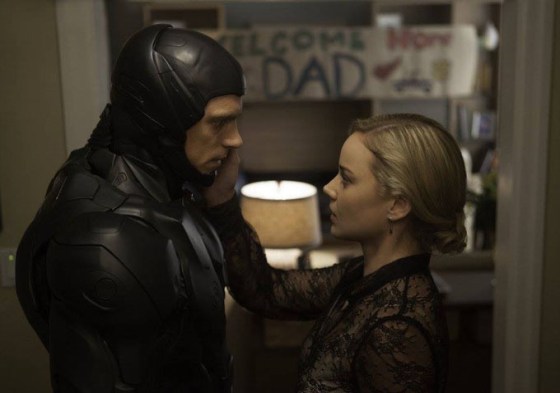 Going into this viewing, I intentionally tried to keep my expectations low, hoping to find even an inkling of something worthy of praise. But RoboCop is so depressingly lackluster and brainless, I’m not sure director Jose Padilha is going to be able to recover from it. Joel Kinnaman and Abbie Cornish are the current leading candidates for the most comatose on-screen couple of 2014 and Gary Oldman should have simply known better. I guess the one thing I can give this latest version credit for, is helping me better appreciate the 1987 original.
Grade: D
Top 6 Lists: Con-Artists
List by-Jarrett Leahy
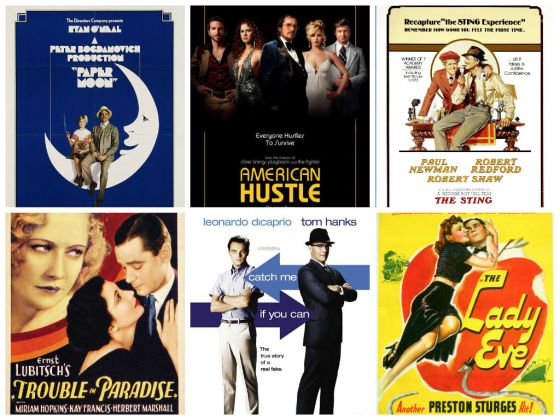
One of the most fascinating and entertaining subject matter in Hollywood has always been the cunning and deviant con-artist. While disdained in real life, the con-artist on screen is an anti-hero that plays on our inner desire to outsmart and outmaneuver, and if The Man is on the other end of those smooth moves, even better. Here are six of the most clever and charming Con-Artist films that never fail to entertain…
6. The Lady Eve (1941) Barbara Stanwyck and Charles Coburn team up in this classic Preston Sturges romantic comedy to try to fleece the future fortune of a brewery heir deftly portrayed by legendary leading man, Henry Fonda. Unfortunately, neither anticipate that Stanwyck will fall for the big lug. If anyone needs convincing in Fonda’s talents in physical comedy, The Lady Eve is the perfect place to start. In the presence of Stanwyck’s Jean, Fonda’s Charles is a stumbling, bumbling klutz who just can’t stop making us laugh.
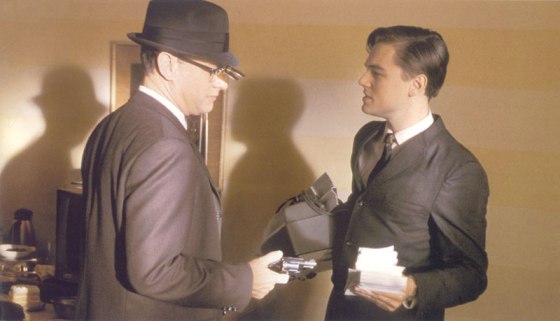
 5. Catch Me If You Can (2002) Spielberg, Hanks, and DiCaprio team up to tell this unbelievably implausible yet true story of this country’s most gifted con-man, Frank Abagnale Jr., who successfully managed to convince others he was a Pan Am pilot, a medically trained doctor, and a skilled lawyer, all before the age of twenty. He also defrauded banks around the world of millions of dollars thanks to his uncanny ability in forging and altering checks. This film is so skillfully created, that some take its impressiveness for granted. While Titanic was his mega breakout role, it is Catch Me If You Can that convinced me that DiCaprio was truly going to be an acting force to be reckoned with for years to come.
 4. Trouble In Paradise (1932) The perfect example of that famed Lubitsch touch, Trouble In Paradise is one of the best films of the 1930s. Miriam Hopkins and Herbert Marshall team up to form a wickedly amusing con partnership with the unsuspecting widowed heiress, played by Kay Francis, in their crosshairs. Unfortunately for them, Francis has her own form of enchanting charisma that may threaten their grand plans. Filled with innuendo and tongue-in-cheek humor that had production code officials up in arms only a few years later, Trouble In Paradise is easily as funny today as it was 80+ years ago.
 3. The Sting (1973) A period piece that harkens back to classic 1930s Chicago, what more can be said about the Best Picture winner of 1973? On a scale of 1-10, Paul Newman and Robert Redford turned the charm up to an 11 as they pull the ultimate con on the man who had one of their beloved friends and partners killed.
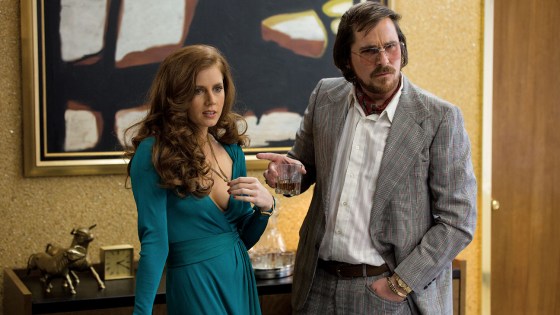
 2. American Hustle (2013) Last year’s latest addition to the con collection is a film that surprisingly it seems you either love or hate. As you can tell, I hated so much I put it at my #2 spot 😉 American Hustle offers a 70s infused, multilayered con that exhibit some the best performances from this talented cast. It has been a true pleasure to witness director David O. Russell find his cinematic voice. If you didn’t dig the vibe of American Hustle the first time, think about giving it another chance, because for me, every viewing has been more and more damn entertaining.
 1. Paper Moon (1973) What a year for con-artist films. With the undying love of The Sting, I’m sure there are quite a few out there that may question my choice of Paper Moon, but Peter Bogdanovich’s black & white masterwork is just too darn entertaining thanks in large part to the impeccable chemistry of the father/daughter duo of Ryan and Tatum O’Neal. Tatum was so good in fact that she was awarded, and rightfully so, the Best Supporting Actress Academy Award at age 10, the youngest winner ever in a competitive category. If you haven’t seen Paper Moon, it’s most definitely worth the effort to track down, if just to be reminded how gifted a filmmaker Bogdanovich was.-JL

(It pained me to have to leave Matchstick Men off this list, it is a skillfully crafted con-artist film from director Ridley Scott that offers one of Nic Cage’s best performances, and that’s coming from someone who doesn’t particularly care much for Nic Cage’s skills as an actor, so I thought I’d just add this little footnote in case you stumble across it, it’s definitely worth checking out)
Dawn of the Planet of the Apes (2014)
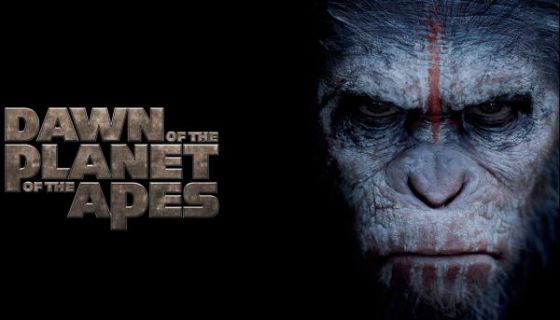 Review by-Jarrett Leahy
Ten years after a deadly pandemic devastated the world population, only small factions of societies still remain. During an exploratory search for an abandoned hydroelectric dam, a group human survivors stumble upon a flourishing community of highly intelligent primates that have taken residence among the forests that now surround the decimated city of San Francisco. Desperate for the electricity that could save their dying community, human leader Malcolm attempts to befriend the apes that reside on the land they are searching. Despite brokering a fragile peace, harmony and understanding between these two societies is under constant threat by contentious fear and suspicion that permeates throughout both communities.
 In 2011, director Rupert Wyatt shocked Hollywood and many film fans with his poignant and deeply moving Rise of the Planet of the Apes. His notable efforts reinvigorated a franchise that had been almost completely decimated by the utter debacle of Tim Burton’s 2001 blunder. New director Matt Reeves has done an admirable job building on success and feel of Rise, creating an even more expressive and emotionally complex story. The film’s human protagonist, Malcolm, is notably brought to the screen by Australian star Jason Clarke. An actor since the mid 90s, the 45-year-old Clarke has recently found critical and professional success in films such as Zero Dark Thirty, The Great Gatsby, and the Depression-era crime drama Lawless. As one of the commanders of the San Francisco population of survivors, Clarke adeptly captures the awed compassion of a man who desperately wants peace between humans and apes. Clarke’s interactions with primate leader Caesar are flawlessly realistic. Never did I question the verisimilitude of their interactions together on screen, which another testament to the dexterity and command he brought to his performance.
 The film’s pervasive use of computer-generated images (CGI) offers a perfect example of how remarkably far the art form has come and unfortunately how far it still has to go. There were unsuccessful moments during the movie where my suspension of disbelief was interrupted, most notably during a scene involving a grizzly bear attack and also during more motion intensive action sequences including scenes involving the apes swinging from tree branches. I also couldn’t help, despite the dire circumstances of the moment it was depicting, but chuckle at the unintended humor of seeing a chimpanzee riding bareback on a horse while double fisting automatic machine guns. It reminded me of something you’d see in an outrageous 1970s grindhouse film. However, praise must also be assigned to the CGI artists and technicians for their amazing advancements in the ability to capture the most subtle of facial expressions offered by the film actors playing these unusual characters. We distinctly see the pain, confusion, and delight these creatures express, offering an extra level of affection and understanding to their plight that the previous films in this franchise rarely offered. It is this connection that makes these last two installments feel so unexpectedly gratifying.
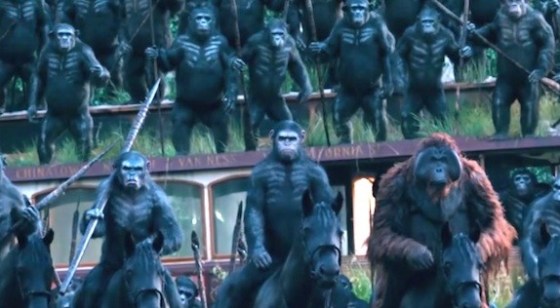 The gifted leader of this computer-generated primate population is motion-capture king Andy Serkis. Serkis has been on the front line of this blossoming sub-genre of acting, offering his unparalleled talents to create such memorable characters as Gollum/Smeagol in the Lord of the Rings trilogy and Kong in Peter Jackson’s 2005 adaptation of King Kong. As the simian leader Caesar, Serkis skillfully captures the confounding emotions of a highly intelligent creature who is deeply conflicted by his love for humans and his allegiance with his fellow primates. He also manages to meticulously demonstrate the unique mannerisms of an animal whose newly found intelligences still at times awkwardly clash with his anthropoidal instincts. For years, fans of Serkis’ work have been begging for the Academy to recognize his unrivaled talents as a motion-capture pioneer with an Academy Award nomination. While his contributions to each of his legendary characters are undeniable, including here with Caesar, what makes it hard to reward him for his acting talents is it is truly difficult to decipher where Serkis ends and the CGI artists begin. Because of that, I honestly can’t imagine him ever being awarded an acting nomination. However, I can foresee him one day possibly receiving an honorary Oscar for prodigious contributions to this emerging faction of the industry.
 Reading over a few of the other reviews for the film, I wish I could be so enthusiastically reverent about the movie, but unfortunately there were a few minor miscues that kept it from reaching the levels of true greatness others have professed. On top of moments where the CGI stumbled slightly, the film’s message of peace and understanding can at times feel a bit heavy-handed, and its awkward depiction some of the secondary human characters bordered on caricature. Overall however, thanks to the notable efforts of Serkis and Clarke, I was pleased to discover that Dawn of the Planet of the Apes is a surprisingly mature and thought provoking sci-fi drama that manages to exceed the accomplished efforts of its predecessor.-JL
 AmateurCinephile.com