By Jarrett Leahy & Jason Chandler
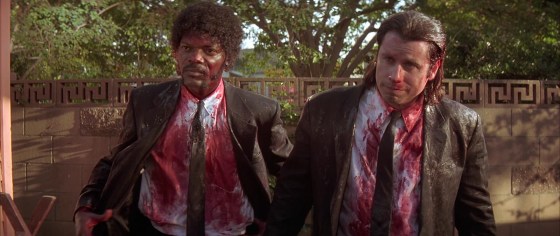
Before 2014 too quickly recedes into our rear-view mirror, we would be wrong not to backtrack just a bit in order to recognize the 20th anniversary of one my all-time favorite films. For this edition of The Joust, I imagine there will be more agreeing than debating, as Jarrett and I discuss the impact of the great Pulp Fiction.-JC
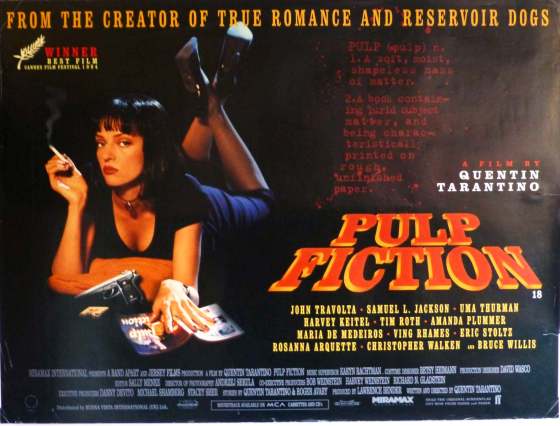 Jason Chandler: I know we both love this movie, as millions of others do, but for me it’s one of those films that started me on a path to becoming interested in the movie-making process. When I saw it for the first time in my college dorm with my roommates, I was equally shocked and fascinated. It pushed passed a lot of boundaries. I really think Tarantino created a whole new movie audience, in a totally new and fresh way, in the 90’s.
Jarrett Leahy: You are correct in your assumption that this latest Joust will be much more cordial than our first one a few months ago where we discussed the merits of Spike Jonze’s masterpiece, Her 😉 Building on your praise, Pulp Fiction was and remains a complete game changer in the world of cinema. It inspired a cottage industry of copycats, giving inferiors like Guy Ritchie a career. However, where we differ is our paths to Pulp Fiction enlightenment. Upon its initial release, I was the robust age of 11. Thankfully, my father had little issue ignoring the R-rating and allowed me to sit in while he watched the Blockbuster rental. While admittedly I had little comprehension for what was truly going on, I remember being wide-eyed by Tarantino’s L.A. underworld crime opus. It was only after I went off to college many years later that I decided to step back into Tarantino’s singular world, and while, even at age 19, I was still unsure of exactly what I was witnessing, I knew I must see it again…and again.
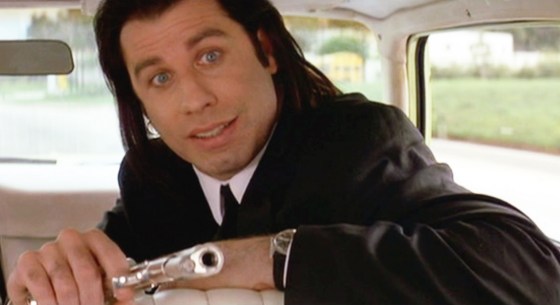 Chandler: That is great stuff. I would have liked to have seen 11-year-old Jarrett’s eyes widen at the sight of Marvin meeting his untimely demise in the midst of Vincent Vega’s “miracle rant.” I know when we first met, Pulp was one of the first movies we found ourselves dissecting, quoting, and re-watching. Despite the insanely good list of films Tarantino has created, I still feel Pulp Fiction is the undisputed champ in his catalog. Where do you come out on that?
Leahy: You recently sent me a link where two Grantland writers discuss the merits of Michael Mann’s film resume, and one of them noted when discussing the film Heat, “Because of how ubiquitous and popular Heat is, we try to downplay how much we love it.” I think there are times I feel the same way about Pulp Fiction. The film’s reputation and acclaim is so huge that it almost feels tiresomely obvious to profess a personal reverence. It’s like saying, “The Godfather is a flawless masterpiece.” But there’s little doubt that, for me as well, Pulp Fiction is Tarantino’s best film. The battle for the number two spot can be a heated debate; Inglourious Basterds, Django Unchained, The Kill Bills, Jackie Brown, and Reservoir Dogs all have a legitimate claim for the runner-up spot, but none of them has topped the magic of his sophomore effort. Saying that, with my loyalty to Pulp, I must confess I’m not sure I’d be able to concede its throne if Quentin ever does make a better film.

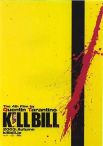
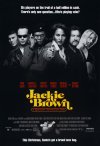
Chandler: It’s mind blowing to consider that all of those films play second fiddle, right? Inglourious, Django, Reservoir Dogs, Kill Bill – if any one of those were made by almost any other director, it most likely would be considered their crowning achievement. But the fact that they all belong to Tarantino and that they can’t dethrone the champ says a whole lot about Pulp as well as QT’s career. So what do you make of Tarantino’s impact after 20 plus years? Hard to think of any other director who has hit so many home runs with virtually no strikeouts in his first two decades (No I don’t consider Grindhouse a strikeout).
Leahy: You’re right, there are very few modern directors who have had such a consistent run of success right from the beginning of their careers. A few that come to mind are Paul Thomas Anderson, Wes Anderson, maybe David Fincher (if you forgive Alien 3), but it seems that even the best filmmakers have a few duds in their movie-making closet. As for your assertion that Grindhouse was not a strikeout, yes I agree; when taken in context of what Quentin and Robert Rodriguez were trying to do with Grindhouse, that project was a success. But, I must concede that I found Rodriguez’s Planet Terror to be more entertaining than Quentin’s Death Proof.
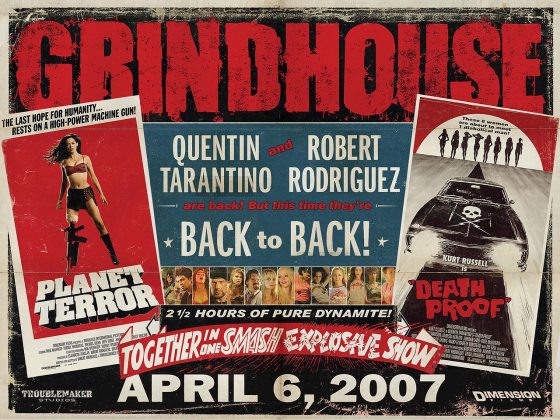 Chandler: Planet Terror was pretty cool, I’ll give you that. Speaking of Robert Rodriguez, he recently interviewed QT on his Director’s Chair series. Tarantino spoke to the fact that the relative lack of box office success for Grindhouse marked the first time he felt a sense of pressure to up his game. I got the sense that in his mind, that was his low point. Needless to say he came out swinging on his next two, so I really don’t see him bogging down anytime soon.
Leahy: So how much longer do you see Tarantino doing this? Can you foresee a day when his audience gets tired of his fan-boy stylings? Do you think he’ll ever venture out to make a more mature piece of cinema or, like most auteurs, stick with his style till the end? I’ll be curious how well his resume ages and whether younger generations of movie fans embrace his trashy, over-the-top sensibilities the way we have. I fear he may overstay his welcome, lose his touch, which could jeopardize his reputation and that of his work.
Chandler: It’s a good question whether audiences will continue to respond to QT’s work. I’m prone to believe they will, simply because he will continue to be the alternative to mainstream cinema, a.k.a. Comic book movies. As for venturing out, I imagine Tarantino’s choices will continue to evolve within his particular style, as it has with Django and Inglourious. But I don’t think and hope that he won’t ever settle for making a “conventional” movie. God knows we have plenty of those to go around.
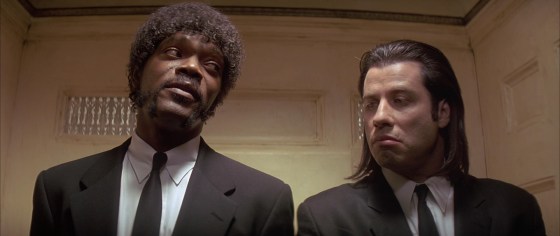 Chandler: Well, Its obvious we could chat about QT’s career and impact for a long time. Twenty years since its release, Pulp Fiction remains one of my Top 3 favorite movies of all-time, and I’m not sure that will ever change. Even with the accolades he has received, I believe Tarantino’s legacy may mirror that of Hitchcock, in that his greatness won’t truly be appreciated until a certain amount of time has passed. Forty years from now I believe film junkies will consider Tarantino to be not only the most influential director of his time, but also the most singular. Before I throw it back to you for your closing thoughts, consider this: The average IMDb score for QT’s first eight movies is 8.1, and his Rotten Tomatoes average critical score is 84%. Pretty impressive digits by any stretch. That wraps it up for me for this edition of The Joust. It’s been fun.
Leahy: Those numbers are impressive, and I hope you’re correct in your prediction about Tarantino’s legacy. I must confess being a little more pessimistic in how influential he will be seen as. Personally, it feels to me that his influence has already produced whatever copycats there were going to be, all of whom proved far less talented than QT—which brings me back to the original premise of this Joust, just how great Pulp Fiction was and still remains. Despite a decade of studio copycats, no filmmaker has ever come close to the visceral power and supremacy of what Tarantino was able to unleash twenty years ago. And I think that will be his lasting impact, creating a film that still shocks, captivates, and entertains despite every major studio’s attempt to steal its thunder and cash in on its brilliance and ingenuity.
Well, it’s been interesting having such an agreeable Joust, but next time lets make sure we pick one of the rare films we don’t quite see eye to eye on. JL signing off…
Editor’s Note: Worst date movie ever!-Michelle Zenor
 Review by-Jarrett Leahy
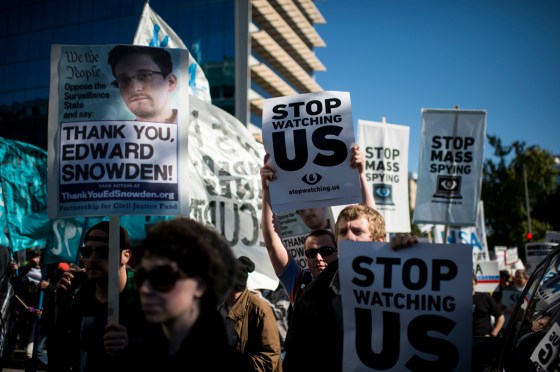
 Made in secrecy and directed by one of this generation’s most gifted documentarians, Laura Poitras, Citizenfour is a taut and edgy examination into the mass collection of digital information by the National Security Agency. Benefiting from unprecedented access, Poitras captures, in intimate detail, the events surrounding Edward Snowden’s disquieting revelations about the illegal actions being perpetrated by the U.S. intelligence community. Coming in at just under two hours, the film only gets more and more terrifying as the realization sets in of what exactly our government has been doing on a daily basis under the guise of the 2001 Patriot Act. Not only an account of the Snowden leak, the film also discloses insights from whistle-blower William Binney, a former thirty-year intelligence official in the NSA who resigned in October of 2001 after being outraged at the direction the NSA was taking and their justifications for unlawfully collecting massive amounts of information. A major critic of both the Bush and the Obama administrations and their unconstitutional spying tactics, Binney’s inclusion into Citizenfour adds yet another level of reputability to this documentary and the information it lays out for its viewer.
 However, for many, the main attraction of Citizenfour is its look at Edward Snowden. A spineless traitor to some, a courageous whistleblower to others, Snowden has become a polarizing figure worldwide as the ramifications of his actions are still being realized nearly two years later. Utilizing a vast collection of encrypted communications, Poitras shows how Snowden secretly reached out to Glenn Greenwald, columnist for The Guardian newspaper, setting in motion the eventual meeting in a Hong Kong hotel room where, over the course of a week, Snowden methodically explains in great detail the sweeping collection of classified data, revealing a systematic abuse and hijacking of today’s internet and cell phone technology, by not only the U.S. government, but others around the world including Great Britain. The information disclosed also appears to indict a handful of high ranking NSA officials of perjuring themselves while testifying to Congress, as they repeatedly denied, under oath, committing the very acts the evidence in Snowden’s possession exposes.
 As a whole, documentary films appear to be the last bastion of investigative reporting, as they are allotted the freedom to show us a more unvarnished look at our world. Unfortunately, the largest flaw I’ve found with many of the political documentaries I’ve watched over the years is, despite good intentions, many of these films are too skewed to one side of the argument or the other, which in turn, alienates half their viewership and muddles the message they are trying to convey. In comparison, the vital component to the overall impact of Citizenfour is its ability to remain neutral. Poitras is aware of the responsibility she has been given to share this story and recognizes that the revelations of Citizenfour are too important to get lost, overshadowed, or dismissed because of perceived political slant.
 As our world becomes more and more interconnected and ever reliant upon technology, this is perhaps the most pressing issue for the future of our society. The decisions we make, or don’t make, will effect generations to come. While easily worthy of this year’s Academy Award, the lasting impact of Citizenfour will be what happens next. I don’t feel I’m being hyperbolic when I say Citizenfour is one of this country’s most important documentaries, for it lays out in great detail the unconstitutional activities our government has been perpetrating in the name of national security. This documentary will undoubtedly be the crowning achievement of Poitras’ legacy as a director, and it joins the likes of Barbara Kopple’s Harlan County U.S.A. as one of the seminal non-fiction films created by a female filmmaker.












 Review by-Jarrett Leahy
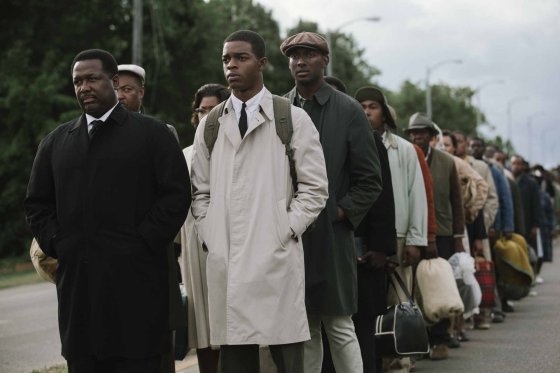 The success of Selma sheds light yet again on the topic of female directors. Despite many great social changes over the last few decades, the lack of equal opportunity for women in film remains a concerning problem in this billion dollar industry. While I look forward to the day when female filmmakers are seen as equals and not treated as some sort of novelty or rarity, the only way to reach some semblance of egalitarianism is if their plight for equality is brought to the forefront, and the merits of their talents are celebrated. So please allow me then to introduce to you filmmaker Ava DuVernay. Born in August of 1972, this Los Angeles native made a splash on the Hollywood scene when her second feature film, Middle of Nowhere, earned her the Best Director prize at the 2012 Sundance Film Festival, becoming the first African-American woman to receive such honors. Selma continues her string of firsts, as she became the first African-American woman to be a Golden Globe nominee in the Best Director category.
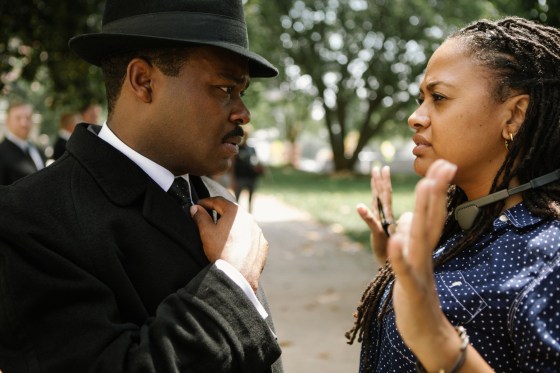 As her third feature, Selma was not originally slated to be directed by DuVernay. Instead, Lee Daniels of The Butler and Precious fame was hired to lead the production. It was only after Daniels stepped down that DuVernay was brought in to helm this biopic at the behest of the film’s leading man, David Oyelowo. Hampered by the fact that another studio had already secured the rights to Dr. King’s copyrighted speeches, DuVernay was forced to write different variations of King’s sermons. While it was initually a bit disheartening knowing King’s authorized words were not being spoken on screen, I must praise DuVernay’s remarkable ability to expertly capture the power and stirring eloquence Dr. King was known for. Never did I feel that the words spoken could not have come from Dr. King’s mouth. DuVernay also does a skillful job recreating that time period’s heightened sense of anxiety. Even with full knowledge of how many of the main events transpired, Selma manages to keep the viewer unnerved to the end.
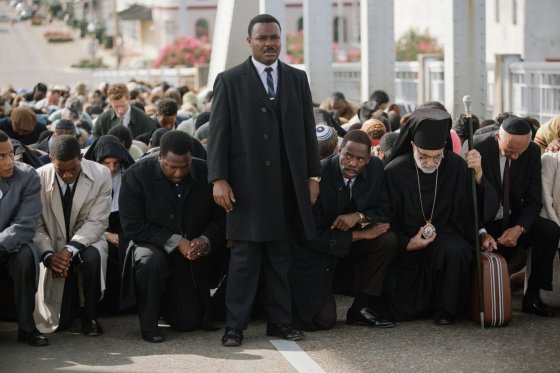 Unfortunately, the film is not free of controversy. Many critics and historians have raised concerns over DuVernay’s dipiction of President Lyndon B. Johnson, played by two-time Oscar nominee, Tom Wilkinson. Known as an ally to the Civil Rights movement, some were left questioning the filmmaker’s choice to characterize LBJ as an unwilling proponent to the Selma cause. If this proves to be true, I too question this unnecessary choice to sacrifice historical accuracy for extra drama. While I’m by no means naïve to the fact that movies take creative liberties with their depictions, there is, far and away, enough melodramatic tension in this gripping story without having to drum up historical falsities. DuVernay should have known better.
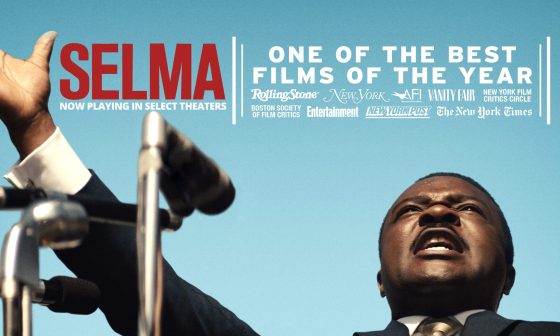
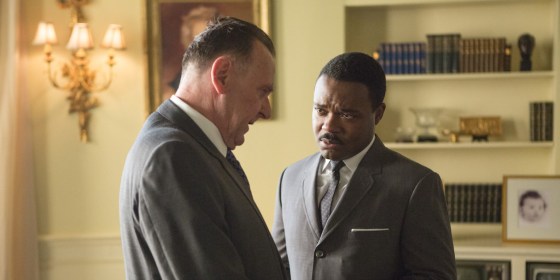 When the 2015 Oscar nominations were announced, as with most years, a handful of omissions or “snubs” were identified and debated. Among those passed over, the most conspicuous is by far David Oyelowo. An English actor and graduate of the London Academy of Music and Dramatic Art, Oyelowo saw Selma as his chance to shine and reportedly fought for over seven years to win the role of Dr. Martin Luther King, Jr. This passionate dedication to the part comes across on screen tenfold. While the physical resemblance is quite striking, it’s Oyelowo’s awe-inspiring ability to capture the mannerisms, aura, and overall presence of this powerful figure in our country’s history that makes this performance one for the record books. Despite the lack of access to King’s exact speeches, Oyelowo’s powerful articulation of Dr. King’s message offers the viewer a stirring portrayal that avoids becoming too reverential and instead brings a level of humanity to such an almost mythical public figure. As the significance of Oyelowo’s omission from the Best Actor category began to truly set in, many investigated, looking for possible explanations as to how and why such a thing could happen. It was later reported that Paramount, the studio behind Selma, failed to send “screeners” of the film to many of the Academy voters before they had to select their nominations. This glaring error on the studio’s part is the only possible explanation I can come up with for Oyelowo being left off the nomination list, for there are not five better performances in 2014.
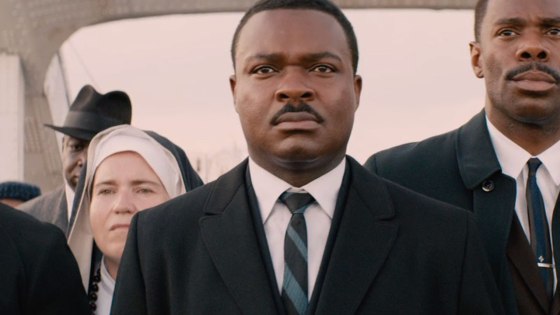 Overall, my appreciation for Selma is a bit more tempered in comparison to some others who have seen it. The issues surrounding the story’s depiction of President Johnson, the lack of Martin Luther King’s true speeches, and handful of unusual cinematography choices were difficult to completely ignore and kept the film from reaching the lofty status some have bestowed upon it. But that’s not to say I’m not impressed with what Ava DuVernay was able to create. Her film dramatically captures the uncertainty and emotional furor of that time period, displaying on screen the reasons why so many African Americans, and whites, were compelled to fight for change. Selma also offers a younger generation of African-American youth a glimpse at the sacrifices it took from everyday citizens to bring about the changes they readily enjoy today. But, despite the Oscar snub, for all intents and purposes, Selma is a Best Actor movie, or a film where the actor’s performance outshines or overpowers the overall film. As time goes on, I foresee Selma settling into some version of relative obscurity, for other than Oyelowo’s performance, there is, unfortunately, nothing all together spectacular to set Selma apart from the recent glut of biopics and keep it at the forefront of critics and fans’ consciousness.
 AmateurCinephile.com