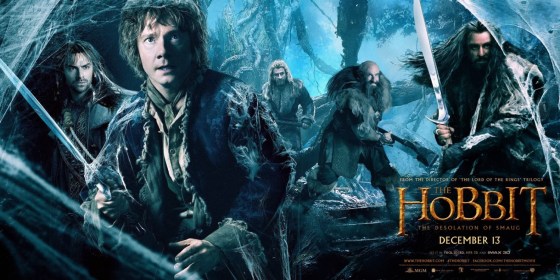
 Review by-Jarrett Leahy
Because, like so many of us, I’m a fan of the Lord of the Rings trilogy, I was curiously optimistic when it was announced a few years back that after a long, drawn out contract negotiation, director Peter Jackson was on board to create a film adaptation of The Hobbit, the Tolkien prequel novel about the adventures of Bilbo Baggins. I became slightly concerned when it was then announced that they were fleshing out the one book to create three films, and after watching the stale and uninspiring first Hobbit film, An Unexpected Journey, I decided not to see The Desolation of Smaug in theaters during last year’s Christmas holiday release. However, with my unexpected enjoyment of the Amazing Spider-Man 2 and with Desolation of Smaug just recently released on DVD, I was inspired to give this franchise reboot a second chance. An hour or so into movie, however, I wholeheartedly regretted that decision.
One of the biggest things I’ve learned from studying the truly successful film critics is, they didn’t become truly successful by telling other people their feelings about a particular movie are wrong. So if you’ve been entertained by these Hobbit films, I really am happy for you. Finding enjoyment in the movies we watch is why we love this hobby so much. However, my utter frustration with this latest film almost caused me to pass on putting together a review. But after a couple of days to let it all digest, I felt skipping it would defeat the purpose of this site, which is to share sincere thoughts and observations about the movies we are watching.
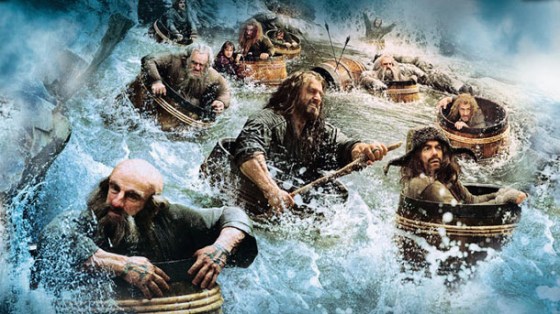
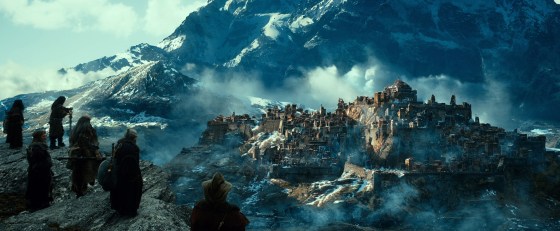 Fair or unfair, The Hobbit trilogy is and always will be compared to its predecessor, Lord of the Rings. Watching Lord of the Rings, there’s little doubt that filmmaker Peter Jackson put his heart and soul, his blood and sweat into those films, and that love and passion truly come across on screen. This was obviously his baby, and we were in awe of what he was able to create and felt honored to be able share in it. Unfortunately, that same love and passion just don’t seem to be present with The Hobbit films. I don’t know why, but it almost feels as if Jackson is simply going through the motions. The artistry and virtuosity that were shown throughout the first trilogy have instead been replaced by an absurd overuse of CGI. There were times I felt like I was viewing a video game as apposed to a film. The biggest illustration of this was a scene involving the dwarfs floating in barrels down a raging river. The computer graphics used to create that scene were so flagrantly obvious that at no point would my eyes allow me believe that any drop of the water depicted was in fact even remotely real.
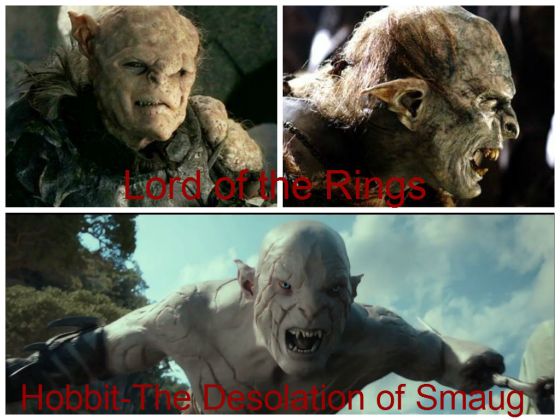
 Another glaring example where CGI was used to cut corners was in the creation of the Orcs. I know for those who haven’t seen any of these films the statement I will make about a mythological fantasy creature will be hard to understand, but the Orcs in Lord of the Rings were truly more realistic. Examining the comparison pictures posted just below, you can see through the extensive use of Hollywood make-up, the facial details of the top Orcs are distinctly grotesque. It’s almost as if you can see and smell the funk coming off these beasts, which adds to their fear factor. When compared, even though I can’t imagine how long and arduous it was for the graphic artists to create these images for the film, the computer generated creatures in Desolation just feel like phony, inferior replacements. The skin appearance is too smooth; there isn’t that same meticulous attention to the minute details that the previous make-up artists were able to generate. That awe-inspiring artistry is again missing.
 One of the most important aspects when it comes to these types of adventure fantasies is you have to care about the protagonist and central characters you are going on this journey with. Lord of the Rings succeeded wildly at this. I was truly emotionally invested in the well being of Frodo, Sam, Arogorn, Gimli, and Legolas as they tried to save Middle Earth. Now, perhaps this statement is more of an indictment of me than the film, but I find the dwarfs to be annoying and, frankly, I just don’t care about the character of Bilbo. Martin Freeman’s unhurried, almost detached delivery of the character may work for some, but for me he lacks the personality or on-screen charisma to lead such a large franchise.
I understand cliff-hanger endings are part of the bag of tricks at the disposal of a filmmaker. But to spend two and half hours plodding along with this repetitive and stale storyline only to have the film end the way does I personally found exasperated my frustrations with the film. After my displeasure for The Unexpected Journey, I’m almost shocked to say that I have even less appreciation for The Desolation of Smaug, but it is unfortunately true. Now the final question that remains is, since I’m already two thirds into this distressingly middling trilogy, do I dare waste my time with the last film, The Battle of Five Armies, which is scheduled for release in December?-JL
 Review by-Jarrett Leahy
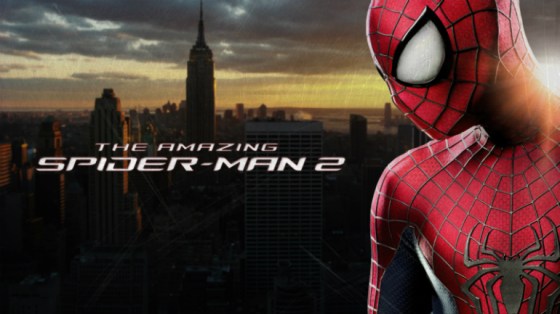
 Filled to the brim with bright, flashy CGI, The Amazing Spider-Man 2 is the visual antithesis of the ominous and brooding Dark Knight series. Some of these CGI laden sequences, like the battle scenes between Electro and Spider-Man, were quite impressive. Others, like the opening plane flight scene, were unfortunately a head scratching mess. Overall, I found that the good outweighed the bad when it came to film’s action sequences. However, if I can make one plea to all future directors of superhero films, please, PLEASE stop having citizen bystanders cheering behind meager metal guardings like lobotomized sacrificial lemmings. It’s an eye-rolling cliché that desperately needs to stop.
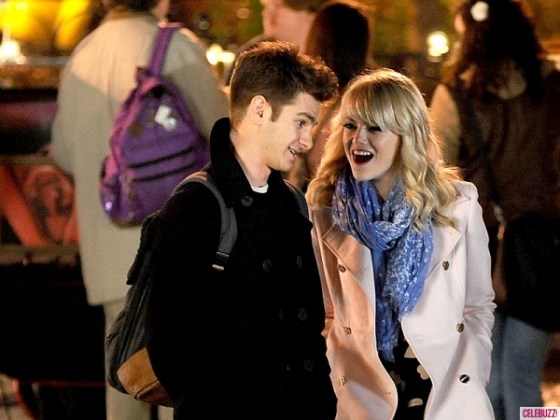 At times obnoxiously snarky, other times coming off like a hackneyed, grinning goon, Andrew Garfield remains the weak link of this franchise reboot. Luckily for us the powers that be were smart enough to bring in a gifted supporting cast to help make up for what Garfield lacks as a leading man. Front and center among these supporting players is Emma Stone. While Garfield might be playing the title role, it is in fact Stone who is the true star of The Amazing Spider-Man 2. Her radiant charisma and alluring magnetism on screen is intoxicating. You simply can’t take your eyes off of her. And when sharing scenes, Stone is able to bring out the best in Garfield thanks in large part to a sincere and charmingly loving chemistry shared between them. Despite my reservations about him, I will be the first to admit the real life relationship shared between these two young actors certainly helps them when on-screen together. With this being Stone’s last Spider-Man, it’s going to be a daunting task for Shailene Woodley to fill her immense shoes.
 Other supporting standouts include 2-time Academy Award winner Sally Field and rising star Dane DeHaan. Field, who plays Peter’s loving guardian Aunt May, brings an assured strength and quiet fortitude to her role. DeHaan perfectly captures the outward brash yet inner turmoil of young billionaire, Harry Osborn while also fully embracing the frenetic and maniacal persona of his alter ego Green Goblin. In comparison, I found Jamie Foxx’s performance to be a mixed bag. His portrayal of obsessive loner Max Dillon was unfortunately a bit too hokey and exaggerated, but once transformed into Electro, I was surprised at how much I enjoyed Foxx’s snarling delivery.
 The Amazing Spider-Man 2 suffers from the studio’s choice to stuff it with a superfluity of villains. Academy award nominee Paul Giamatti seemed to be treated like an afterthought, as his wacky performance of Aleksei Sytsevich felt as if it were some sort of last minute throw in. Saying that, I’m shocked to admit that, carried by Emma Stone’s beguiling performance, this second installment from director Marc Webb is a much more satisfactory movie experience than his disappointing first effort. It’s just a shame Stone won’t be around for Spider-Man 3 and 4. (that’s right, there are at least two more of these coming)-JL
 Review by-Jarrett Leahy
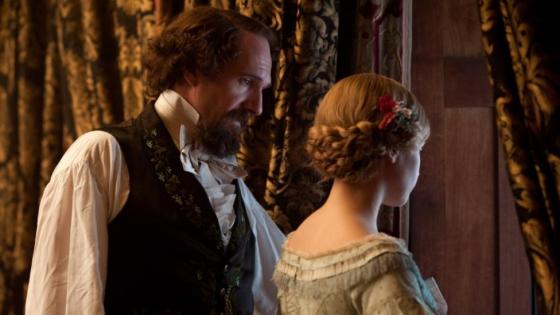 Issues arose almost from the start. During the rehearsal scenes for The Frozen Deep, the use of a hand held camera to capture interactions on stage left me dizzy. Severe light contrasts meant to give the film an aged look instead just cause it to look dark and dingy. Odd jump cuts in the story’s timeline become a distraction, hindering the narrative flow. Fiennes’ overuse and choice of framing for close-ups were also frustrating. Too many times we see Nelly, Felicity Jones’ character, shot on a slanted downward angle, as if the camera were drunkenly looming over her. Other close-ups meant to convey some sort of passionate angst instead came across as some sort of bad 19th century perfume ad. I was seriously waiting for one of the actors to turn to the camera and whisper, “Calvin Klein.”
 It’s not an enjoyable thing to write a negative film review, but unfortunately as we all know, not every film succeeds. Hampered by questionable camera shots, lighting choices, along with a dreadfully emotionless performance from Felicity Jones, The Invisible Woman is a disappointing sophomore directorial effort from Ralph Fiennes. How such a lascivious and passionate premise for a film could come off so austere and frigid is beyond me. There is a sultry, scandalous love story in their somewhere. Fiennes just wasn’t able to deliver it.-JL
 Review by-Jarrett Leahy
 When it comes to Japanese animation, there is no bigger filmmaker than the legendary Hayao Mayizaki. For close to forty years, Mayizaki has been creating some of the finest examples of animated storytelling that are praised not only amongst his peers in the animation world, but throughout all of cinema. Admittedly I’m still a bit of a Mayizaki novice myself, for of the ten feature films he’s created since 1979, I’ve only had the opportunity to see two others, My Neighbor Totoro and Spirited Away. Set largely in the decade leading up to the second World War, The Wind Rises tells the fictional story of Jiro Horikoshi, a character partially based on the famed Japanese aeronautical engineer Jiro Horikoshi, who was in fact the chief designer of many of the aircraft purchased and used by the Japanese military during WWII.
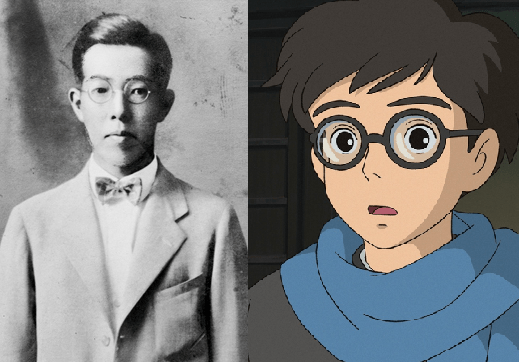 With the complex and delicate nature of some of the film’s subject matter, controversy arose upon the film’s release. Some expressed issues with Mayizaki’s choice to highlight a man who was the main creative force behind so many “killing machines,” while others raised concerns about the film’s glossing over the fact that some of the workers who built Horikoshi’s designs were in fact Chinese and Korean citizens forced into labor by the Imperial Japanese Army. Those concerns are completely understandable, and I wouldn’t dare say those people were wrong for raising them. In fact, I’m glad that they were brought to light. While researching the background story that inspired The Wind Rises, I came across this quotation from Horikoshi’s personal diary on his Wikipedia page that I thought would help better explain where he stood when it came to WWII: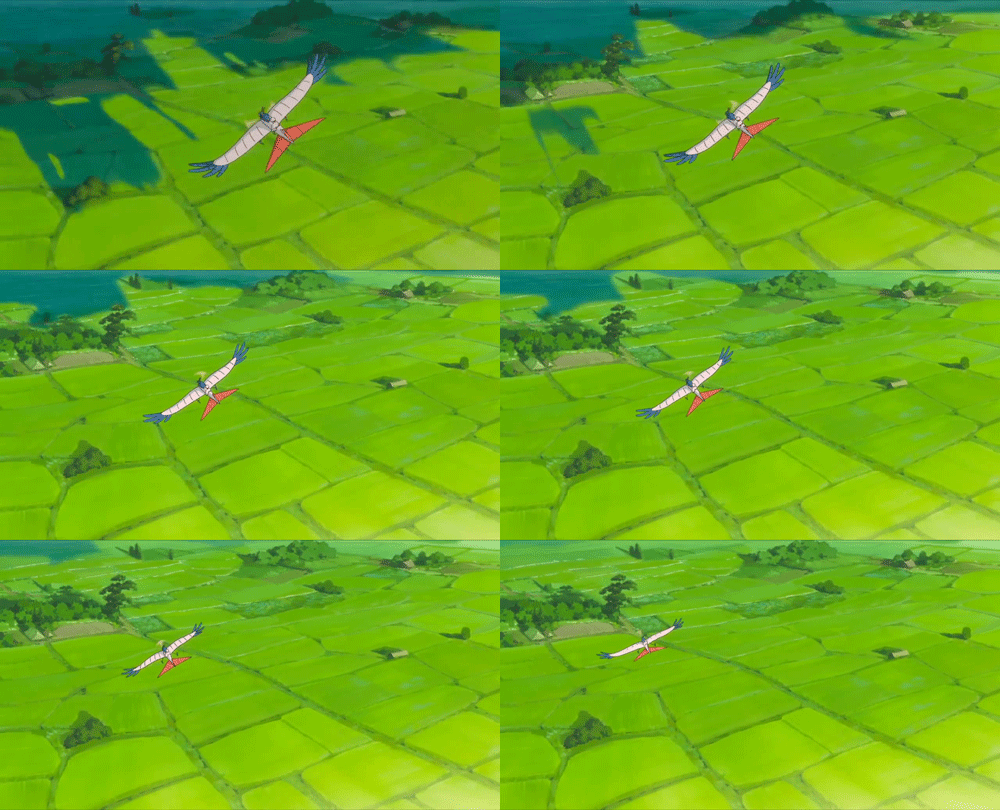
 The Wind Rises is not all doom and gloom. There is a touching and wistful subplot where Jiro meets and falls in love with a delicate, lovely young woman, highlighted by a beautifully enchanting courtship scene at a mountainous resort retreat. Without saying a word and aided by the lovely musical score, a paper airplane, and a few comical blunders, we witness these two kindred spirits fall deeply for one another. While watching it, I felt like I was watching a scene taken right out of a Charlie Chaplin silent classic.
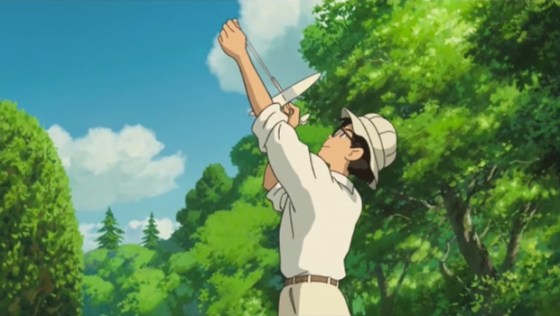 Originally recorded in Japanese, Walt Disney Studios, the U.S. distributor, recruited some of the finest talent including Joseph Gordon-Levitt, Emily Blunt, Stanley Tucci, William H. Macy, and Werner Herzog to dub the dialogue in English, which allows the viewer to better consume the visual artistry created by this master storyteller. Through the use of an evocative and haunting soundtrack, Miyazaki has created a fascinating WWII period drama that shows yet again the unlimited possibilities of the animation genre. Despite its initial controversy, The Wind Rises is an exhilarating, magical film experience that arouses a wide range of emotions thanks to its stunning dream sequences, sweeping landscapes, and a heartfelt love story.-JL
 JARRETT’S TOP 10







 AmateurCinephile.com