 Review by-Jarrett Leahy
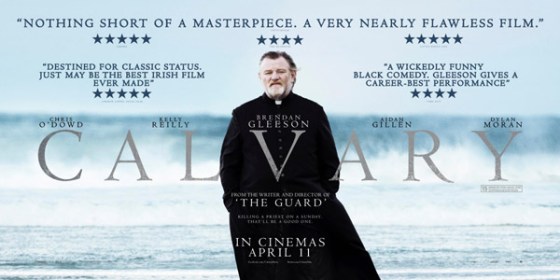
During Sunday confessionals, one of Father James’ parishioners calmly informs his confessor that he plans to kill the small-town Irish priest in one week’s time. Shaken but resolute, Father James makes a conscious effort to continue his daily duties. But as the week draws to an end, it becomes more clear that someone in his community is truly out to get him. Uncertain of the identity of this covert aggressor, James must come to terms with growing possibility of his own mortality while mending fences with his troubled daughter from his life before priesthood.
 English born writer/director John Michael McDonagh, brother of director Martin McDonagh (In Bruges, Seven Psychopaths), made his own splash in 2011, teaming up with veteran Irish actor Brendan Gleeson to create the sleeper hit comedy, The Guard. Calvary, McDonagh’s sophomore effort, which also stars Gleeson, is a much bolder and more gripping achievement, astutely addressing ponderous topics, including the recent scandals in the Catholic church, with a deft touch that never comes across as preachy or judgmental. Blessed with a cast of British and Irish actors known more for their comedic gifts, McDonagh manages to incorporate a large dash of black humor that helps lighten some of the film’s more sobering moments. Like any great who-done-it mystery, McDonagh creates a slew of dead-end clues and characters, all adding their own uniquely twisted contribution to this masterstroke of a film.
 It is through the film’s powerful lead performance that this intrepid character study comes to life on screen. Born in Dublin, Ireland and originally a TV actor, Brendan Gleeson’s big break came when he was cast to play Hamish in the 1995 Best Picture winner, Braveheart. Since then, Gleeson, a three-time Golden Globe nominee, has become a favorite of many of today’s most talented filmmakers, including the likes of Martin Scorsese (Gangs of New York) and Steven Spielberg (A.I. Artificial Intelligence). In Calvary, Gleeson’s portrayal of Father James is truly something to behold. Fully embodying his character’s candid, tough-mindedness, Gleeson’s distinctly chiseled facial features expertly exude every inner emotion on his prominently-bearded face. In this career-defining role, Gleeson has proven with Calvary that he belongs among the names of today’s most gifted working actors.
 Calvary’s cast of supporting actors includes Chris O’Dowd, who delivers a truly memorable against-type portrayal of town butcher, Jack Brennan, and Domhnall Gleeson (About Time) who is was almost unrecognizable in his cameo as incarcerated cannibal, Freddie Joyce. However, the standout supporting performance comes from Kelly Reilly who plays Father James daughter, Fiona. Originally from Surrey, England, Reilly has found recent success, first working along side Robert Downey, Jr. and Jude Law in 2008 blockbuster Sherlock Holmes before wowing critics with her stirring portrayal in the 2012 Denzel Washington drama, Flight. In Calvary, Reilly plays Fiona, a damaged woman who is in desperate need of the love and support of her father, a man she feels abandoned her after the death of her mother. As Fiona, Reilly brings a truly touching and somber performance to a character, emoting a genuine vulnerability of a woman who is on the brink.
 The look of Calvary is a somberly hypnotic feast for the eyes. Set among the coastal cliffs of Ireland, the sweeping vistas and seascapes add yet another level of wonderment to this already impressive film. Cinematographer Larry Smith, who is best known for his work with director Nicolas Winding Refn (Only God Forgives, Bronson), brings an expert eye to the forlorn appearance of Calvary. Utilizing Ireland’s dense cloud cover, the bleak and austere feel Smith captures plays perfectly with the film’s dark subject matter.
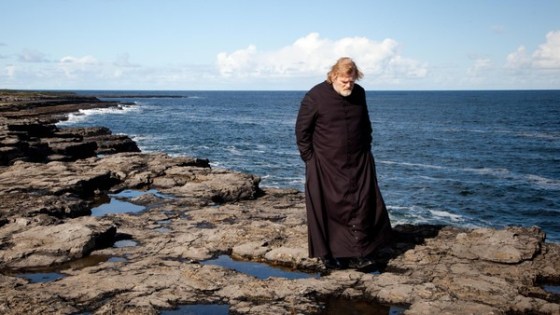 As the end credits began rolling, the entire theater sat in silence. Finally, when we began shuffling out, I remember thinking, that’s the type of cinema experience I hope for every time I sit down to watch a film. Building on the success of The Guard, McDonagh and Gleeson have teamed up yet again to create a darkly funny, thought-provoking masterwork. As for Gleeson, I have yet to see a more powerful performance in 2014. If he doesn’t receive an Academy Award nomination, it would be a mortal sin. Part who-done-it detective story, part black comedy, part modern western, part classic tragedy, Calvary is a stirring, heartrending, meditative reflection on faith and forgiveness that has already claimed its place on my end-of-year, Top 10 list.-JL
Grade: A+
 Review by-Jarrett Leahy
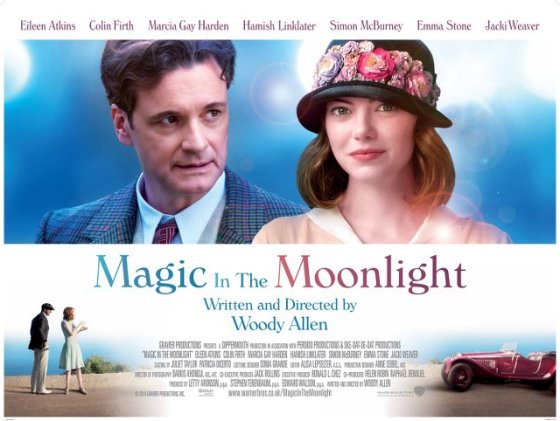
 Regardless of your feelings about his personal life or the art he creates, there is no denying that legendary filmmaker Woody Allen is an unstoppable force in the world of cinema. Since 1966, Allen has created 44 films. That is 44 movies in 48 years! Within that group, there have been all-time classics, cult favorites, and, of course, few forgettable misfires. But even most Allen misfires offer some level of enjoyment that keeps us coming back year after year to see what his latest creation has to offer. While so many great auteurs of the past stayed locked into one type of genre, what makes Allen an even more impressive artist is his ability to create films that span vast variety of genres, themes, and stories. One of his favorites he continues to return to is the period piece, and Magic in the Moonlight is his latest.
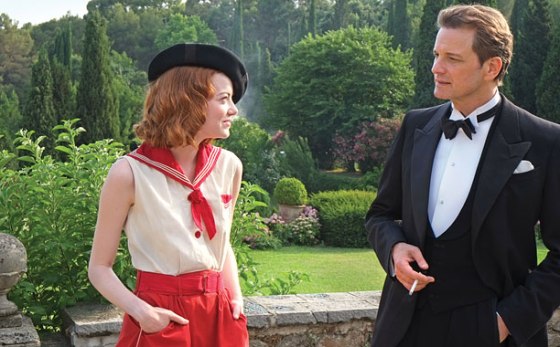
 Set in the south of France, Magic in the Moonlight expertly captures the stunningly beautiful landscape of the French Riviera. Cinematographer Darius Khondji’s adept utilization of natural light creates a saffron glow that, combined with an authentic 1920’s wardrobe and an almost overabundant infusion of ragtime jazz, gives the picture a period-appropriate look and feel. Unfortunately, for a film labeled a love story, Magic in the Moonlight’s two leads, Colin Firth and Emma Stone have very little onscreen spark or sizzle. While I’m sure their 27-year age gap may have been partially to blame, the film’s bigger issue is the Allen-written script which I found disappointingly lacking. For a filmmaker who is even more heralded for his gifts as a writer, I was surprised that much of the dialogue created for these two gifted artists feels flat and awkwardly choppy at times. While Firth methodically captures the logic-ridden arrogance of his uppish English character, and Stone’s absent-minded whimsy was a cheeky pleasure, when together, I found their interactions to be lifelessly vanilla. The overall story, while by no means bad, still came across a bit bland, mundane, and far too predictable.
 I will never turn down the opportunity to see a Woody Allen film in theaters, for I find even his average films are still more sophisticated and thought-provoking than most of the swill that is peddled today as entertainment. Saying that, Magic in the Moonlight is one of those average Woody Allen films. Starring two extremely talented and charismatic actors, Magic in the Moonlight is a love story that suffers from a middling script. With its title, I expected there to be more…magic. Instead, Allen gives us a whimsically safe, by-the-numbers 1920’s period piece that I found quite vanilla.
 Review by-Jarrett Leahy
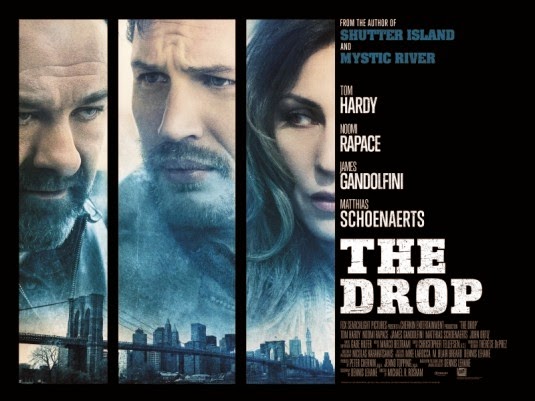
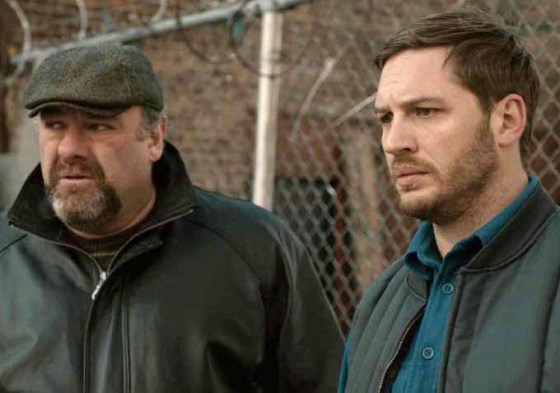 Originally assigned to Neil Burger before he backed out to make Divergent, The Drop is the second feature film of Belgian filmmaker Michael Roskam. Roskam found tremendous success when his debut film, Bullhead, was nominated for a 2011 Best Foreign Film Academy award. Penned by Dennis Lehane (Mystic River, Gone Baby Gone), The Drop proves yet again the adage that a film’s third act can make or break the movie. For the first two-thirds of the film, Roskam slowly weaves a delicate crime tapestry, introducing a densely intertwined narrative filled with little, unexplained comments and shared looks, aiding in the film’s uneasy buildup. As the film reaches its boiling point, Roskam unleashes The Drop’s final ten minutes—a powerful culmination that highlights, explains, and put into context all that came before. I walked out of the theater enthralled, with an urgent desire to watch the film a second time, so I could pick up on moments missed or discounted.
 Best known for his iconic role in the Sopranos, last year’s tragic death of James Gandolfini left quite the void in the acting world while giving The Drop the distinction of being his final film. Marv, Gandolfini’s character, is a former neighborhood gangster who is still bitter more than ten years after losing ownership of his beloved bar when the Chechen crime syndicate moved into Brooklyn. For an actor who built his career playing hoodlums, I found it quite fitting that Gandolfini’s last role would be of a washed-up, has been. Ever the professional, Gandolfini expertly captures the overwhelming frustration of a man who used to have it all. Abrasively conniving with delusions of past grandeur, you don’t know whether to loathe or root for this poor sap.
 Despite the film’s overwhelming hype as Gandolfini’s final performance, the true headliner of The Drop is English actor Tom Hardy, an artist who continues to show a boundless range. As the film’s protagonist, Bob Saginowski, Hardy’s reticent portrayal captures the loneliness of a man whose quiet disposition hides a past life. “I’m not like them, I just tend bar,” Bob says repeatedly to Nadia, the new romantic interest in his life, as if trying to convince himself of that more than her. Bob’s lifelong bond to cousin Marv, however, is threatening to unhinge this delicate new life he’s created, and as secrets are revealed, it is this inner turmoil of past digressions that fuels Hardy’s stellar performance. I’m sure I’ve come off a bit of a broken record with my praise of this particular actor, but the run of success Hardy has had over the last half decade is reminiscent of Edward Norton’s achievements during the mid to late 90’s. And like Norton, I fear Hardy’s accomplishments will go unrecognized by the Academy.
 Not until the final credits rolled did I fully grasp the genius of what The Drop has to offer. Director Michael Roskam takes a darkly arresting Dennis Lehane screenplay and gives us yet another highlight reel of vast acting abilities of Tom Hardy. A film that slowly simmers to a boiling crescendo, The Drop is also a fitting tribute to screen legend James Gandolfini, who made a career out of living in this criminal underworld.-JL
 Review by-Jarrett Leahy
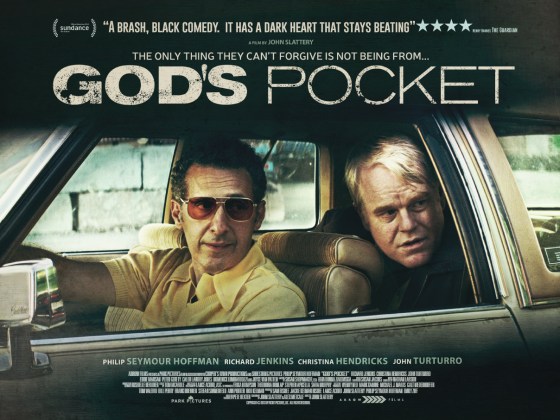
 Adapted from the 1983 novel of the same name, God’s Pocket joins last year’s polarizing Lee Daniel’s drama The Paperboy as film adaptations of works from author Pete Dexter. Dexter, who was awarded the 1988 U.S. National Book Award for his novel Paris Trout, began his career as a columnist for the Philadelphia Daily back in the late 1970’s. Using the notorious South Philly neighborhood of Devil’s Pocket as the basis for his fictional story, Dexter created God’s Pocket following a real incident in which an angry group of locals attacked and severely injured him after one of his columns about a drug-deal-gone-wrong murder angered the victim’s family.
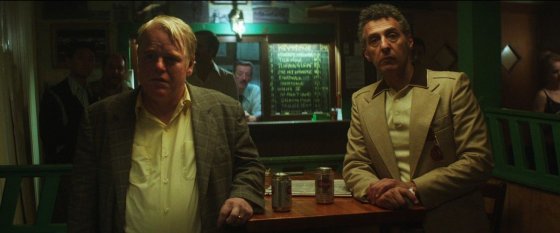 God’s Pocket is the feature directorial debut of Mad Men star, John Slattery, who also co-wrote the screenplay. While delving into this sordid world, I appreciated Slattery’s decision, with the help of famed cinematographer Lance Acord (Lost in Translation, Being John Malkovich, Adaptation), to give his picture a clean, more timeless look. These days it seems so many filmmakers feel an obligation to make their period dramas look like they came right from the time period they’re depicting, often leading to cinematography that has a distinctly tinted hue. Slattery confidently avoids the trappings of stereotypical ’70’s trivialities or visual cliches, and his infusion of a farcical undertone was another unexpected delight. While replete with its fair share of acutely violent moments, I found myself laughing at a slew of peculiar incidents that came across as darkly comedic.
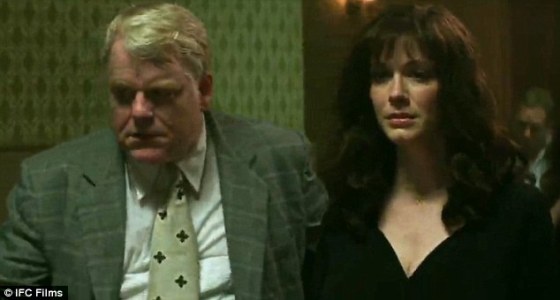
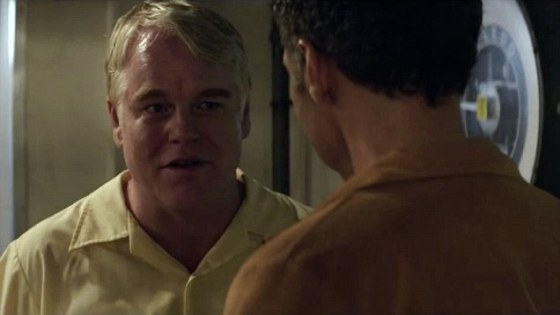 With the recent death of Philip Seymour Hoffman, God’s Pocket has attained an extra level of notoriety, now being one his last pieces of cinematic work. Hoffman’s character, Mickey Scarpato, is not originally from God’s Pocket, and he’s reminded of this fact whenever possible by those who are. While never said outright, it’s alluded to that Mickey is not Leon’s biological father. This creates an unusual emotional dynamic between Mickey and his wife, Jeanie. Hoffman expertly captures the delicate confusion of wanting to be there for the woman he loves, while fully knowing that his feelings of loss can’t come close to hers. Adding to his predicament, Mickey is short on cash, and his desire to handle all of the funeral arrangements for his wife unravels one of the film’s more twisted subplots involving sleazeball, local funeral director, Smilin’ Jack Moran, fitly portrayed by talented character actor, Eddie Marsan. Blessed with the rare gift to inhabit any character thrown his way, Hoffman is yet again at the top of his game, validating my belief that his portrayal alone was worth giving God’s Pocket a chance.
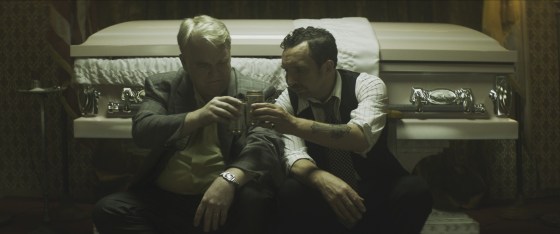 Joining Hoffman is a diverse list of veteran actors including John Turturro and Richard Jenkins along with Slattery’s fellow Mad Men co-star Christina Hendricks. Turturro, who has played his fair share of hustlers and crooks over his career, brings a welcomed gentleness to his portrayal of wanna-be hood/florist Arthur “Bird” Capezio. Jenkins character, Richard Shellburn, is a blowhard, alcoholic columnist who has made a career writing condescending editorials disguised as tributes to the neighborhood. Fueled by implausible amounts of alcohol consumption (I distinctly remember chuckling at the sight of Jenkins bellied up to the bar with five vodka screwdrivers lined up in front him), it was pretty easy to see that Shellburn was slowly unhinging from life’s realities and embracing the caricatured celebrity status his writing had created for him. If any actor can expertly capture a man unhinging from reality, it is certainly Richard Jenkins. His twisted, idiosyncratic delivery offers a level of amusing uncertainty, as you never know when this disturbed lush is going to officially crack.
 Like many, I originally chose God’s Pocket strictly for Hoffman. But as this unusually compelling and darkly humorous tale of crime and neighborhood camaraderie unfolded, I found myself sucked into a world of third-rate hoods and working stiffs. Under Slattery’s competent direction, God’s Pocket never judges or patronizes the working class members of this singular neighborhood, instead using their unique perspectives on life to accentuate this intriguing and poignant drama. While not a groundbreaking effort, as a debut film, God’s Pocket shows that John Slattery has great potential as a future filmmaker.-JL
 Review by-Jarrett Leahy
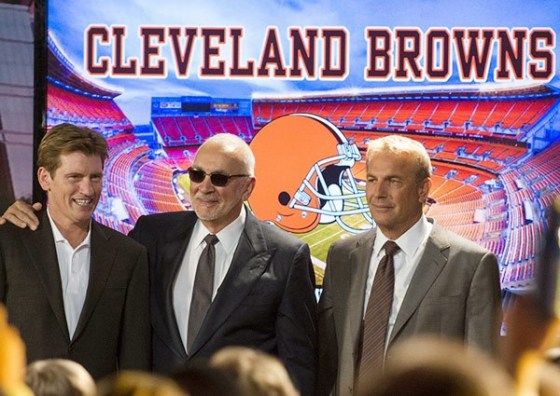 The National Football League is a massive sports juggernaut that only continues to grow. Adding to the league’s acclaim is the recent explosion in the popularity of fantasy football. More and more football fans are turning to this highly addictive hobby, as it allows them to show off their own managerial skills while possibly winning cash prizes. I suspect this overwhelming adoration for fantasy football was one of the driving factors in the creation of Draft Day, as it is a film that explores the inner workings of a football front office during one of the most exciting times of the off-season, the draft.
 Draft Day’s biggest surprise was seeing how much the NFL embraced the film, rolling out the proverbial red carpet, complete with a slew of famous cameos including one from commissioner Roger Goodell. Their expert contributions added a level of reputability to a movie whose melodrama was heightened significantly to help aid the film’s tension and suspense. Unfortunately, Draft Day’s story has a few hiccups, most notably its exaggerated behind-the-scenes wheeling and dealings which felt unrealistic to the point of being almost asinine. Anyone with the most basic knowledge on how the draft works will likely call malarky when they encounter the trades that Cleveland manages to complete. More than a few times, I needed to remind myself this is a Hollywood story.
 A Summit Entertainment production, Draft Day is the creation of long-time director Ivan Reitman. When examining the directorial career of Reitman, it has a tale-of-two-resumes look to it, as the same man who gave us the cult comedy classics Meatballs, Stripes, and Ghostbusters is also responsible for Twins, Kindergarten Cop, Junior, Evolution, and My Super Ex-Girlfriend. Reitman’s last effort, No Strings Attached, was a respectably forgettable romantic comedy starring Natalie Portman and Ashton Kutcher. With Draft Day, Reitman tries to capture the admiration and devotion so many football fans have for the league and the history of the game. Unfortunately, the torrent of reverential tales of lore slowly begin to wear thin. Another troublesome choice was Reitman’s overabundant use of atypical split screens where one character would strangely cross into the other’s screen space. Serving no narrative purpose, I found them to be odd, visual distractions.
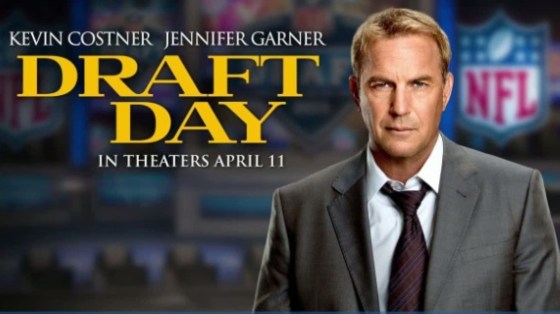
 Despite its flaws, Draft Day is yet another reminder that Kevin Costner is back, as he takes the character Sonny Weaver and truly makes it his own. Costner’s aura exudes the outward confidence of an NFL executive, but what makes this performance a solid stand out for Costner is his ability, with just a subtle look, to emote the inner anxiety of a man under immense pressure from not only his owner and coaching staff, but from a growing list of personal turmoils that includes the recent death of his father, the Cleveland Browns coaching legend Sonny Weaver Sr.. Aiding Costner is a solid supporting cast that includes veteran actors Jennifer Garner and Denis Leary. Playing Costner’s love interest and the team’s salary cap expert, Garner does a satisfying job infusing some genuine charm into a character that is pretty one-dimensional on paper. And while it was difficult to picture Leary as a Super Bowl winning head football coach, his gift for biting humor does help add a handful of amusing exchanges between his and Costner’s character.
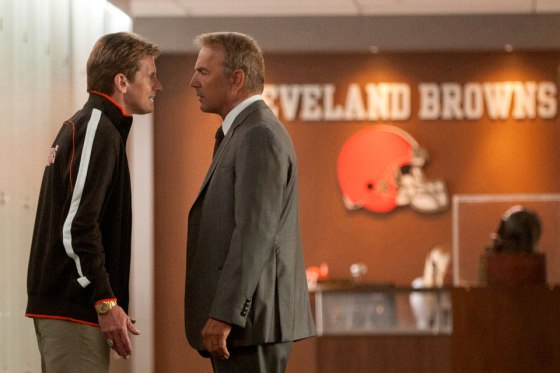 Sports movies always have to walk a tightrope of not coming off as too corny or histrionic, but for as unrealistic and overly melodramatic as Draft Day gets, I’m kind of surprised to admit I didn’t hate it. For this I credit Kevin Costner whose portrayal of charismatic NFL executive Sonny Weaver is the film’s lasting highlight. Draft Day isn’t one of Ivan Reitman’s best efforts, but he’s more than proven he can do a lot worse.-JL
 AmateurCinephile.com